
If you’ve ever felt that telltale heat in your earlobes just two hours after putting on a pair of “nickel-free” earrings, you know the frustration. It starts as a tingle, turns into a burn, and ends with red, weeping skin that takes days to heal. For those of us with sensitive skin, jewelry shopping isn’t just about style—it’s about survival.
Finding hypoallergenic jewelry for sensitive skin has become a minefield of marketing buzzwords. In 2026, simply being “nickel-free” isn’t enough because the industry standards for that label are surprisingly loose. To help you stop the itch, we’ve deconstructed the science of skin-safe metals so you can wear your favorite pieces without the medical aftermath.
Why Your Skin Rebels: The Science of Metal Hypersensitivity
Your skin isn’t being dramatic; it’s an immune response. When certain metals—primarily nickel—come into contact with your sweat, they release ions. These ions penetrate the skin’s barrier, causing your immune system to flag them as invaders. This results in contact dermatitis, characterized by itching, swelling, and rashes.
Identifying the Hidden Villains: Metals to Avoid
Most people think they are allergic to “cheap jewelry,” but the culprit is often the base metal hiding under a thin layer of plating.
- Nickel: The #1 cause of jewelry allergies. Even “nickel-free” items can legally contain trace amounts.
- The Gold-Plated Trap: Many affordable brands use brass or copper heavily alloyed with nickel as a base. Once the 0.5-micron gold flash wears off, your skin is exposed to the allergen.
- Lead & Cadmium: Often found in ultra-fast fashion jewelry, these aren’t just allergens; they are toxic heavy metals.
The “Safe List”: Top Metals Recommended for 2026
To ensure your non-reactive jewelry stays comfortable all day, you need to look for materials with high biocompatibility.
1. Grade 5 Titanium: The Gold Standard
Titanium is the hero of the piercing world. It is used in medical implants because the human body does not reject it. It is 100% nickel-free and incredibly lightweight, making it perfect for heavy statement earrings.
2. 14k/18k Solid Gold: Luxury Meets Safety
While 24k gold is too soft for daily wear, 14k solid gold is an excellent balance. It contains enough pure gold to be inert for most people. However, if you are extremely sensitive, avoid white gold, as it is often alloyed with nickel and plated in rhodium which eventually wears away.
3. Niobium: The Hidden Gem
Often overlooked, Niobium is a chemical element that is naturally hypoallergenic. It’s highly resistant to corrosion and can be anodized into vibrant colors without using toxic dyes or plating.
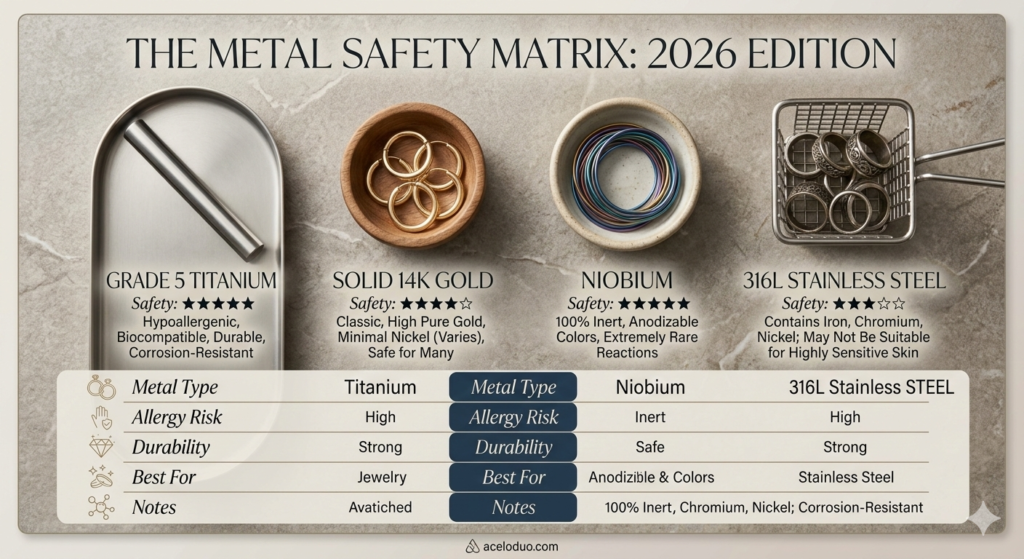
[Data-Driven] The 2026 Metal Safety Matrix
Before you buy your next pair of nickel-free earrings, check this comparison to see how your choice stacks up.
| Material | Safety Rating | Durability | Best Use Case |
| Grade 5 Titanium | 10/10 | High | New Piercings / 24/7 Wear |
| Solid 14k Gold | 9/10 | High | Investment Pieces |
| Niobium | 10/10 | Medium | Colorful/Artistic Styles |
| Sterling Silver | 6/10 | Medium | Occasional Wear |
How to “Test” Your Jewelry at Home
If you have an old favorite that causes a reaction, you don’t necessarily have to throw it away. Here is a “tested” hack:
- The Jewelry Shield: Apply a professional-grade jewelry sealant (not nail polish, which can flake and irritate further) to the posts.
- The Magnet Test: Most high-quality skin-safe metals like gold and titanium are non-magnetic. If your “gold” earring sticks to a strong magnet, it likely has a heavy nickel or iron core.
According to the American Academy of Dermatology, avoiding the trigger is the only way to prevent the allergy from worsening over time.
FAQ: Your Questions Answered
Q: Can I wear 925 Sterling Silver if I’m sensitive? A: It depends. 925 silver is 92.5% silver and 7.5% copper. While copper is usually safe, some lower-quality silver uses nickel in that 7.5% margin. Always look for “nickel-free” sterling silver.
Q: Why do my ears itch even with gold? A: You might be reacting to the copper or silver used to harden the gold. Try switching to Aceloduo’s Titanium Collection for a truly inert experience.
Ready to Wear Jewelry Without the Worry?
At Aceloduo, we believe you shouldn’t have to choose between your health and your style. Our curated collection of hypoallergenic jewelry is designed specifically for those who have struggled to find high-fashion pieces that don’t bite back.