

You’ve seen the look a hundred times. A delicate stack of necklaces sitting just right against someone’s collarbone — different lengths, different textures, somehow perfectly balanced without being overdone. It looks effortless. Like they just grabbed a handful of chains and they happened to land beautifully.
Then you try it at home. One necklace slides on top of another. The chains tangle before you’ve even left the bathroom. You spend five minutes trying to separate two identical-length pieces from each other, give up, and go back to wearing just the one.
Here’s the thing: that effortless look is not actually effortless. There’s a logic to it — a very simple one — and once you understand it, layering necklaces stops being frustrating and starts feeling like the most satisfying part of getting dressed. This guide covers the whole formula: which lengths to combine, how to choose pieces that won’t fight each other, how to keep everything tangle-free, and how to build a stack that feels like you rather than a jewelry store display.
Key Takeaways
- The foundation of any layered necklace look is length separation — pieces should be at least 1 to 2 inches apart to sit independently and not tangle
- A classic beginner stack uses three lengths: 16 inches (collar), 18 inches (collarbone), and 20 to 22 inches (chest)
- Mixing chain textures — smooth with textured, thin with slightly heavier — prevents tangling and creates visual interest at the same time
- Put the thinnest chain on first, then layer heavier pieces over it; this keeps delicate chains from getting trapped underneath
- Mixing gold and silver is no longer a rule to avoid — done intentionally, it’s one of the most modern and wearable looks
The Only Rule That Actually Matters: Length Separation
Everything else in necklace layering — the metals, the pendants, the textures — is creative. Length is structural. Get the lengths wrong and nothing else will save the look.
The reason layered necklaces tangle is almost always that two pieces are sitting at the same level. When chains share the same length, they compete for the same space and move together every time you do. They cross over each other, catch on each other’s links, and by midday you have a knot that takes ten minutes and a pair of tweezers to undo.
The fix is simple: leave at least one to two inches of vertical space between each piece. This gives every chain its own zone to occupy and move in. They’ll still shift throughout the day, but they’ll shift independently rather than into each other.
In practice, this means resisting the urge to buy two necklaces that are close in length. A 16-inch and an 18-inch necklace will layer. A 17-inch and an 18-inch necklace will tangle. That one inch of difference is not enough.
Necklace Lengths and Where They Actually Sit
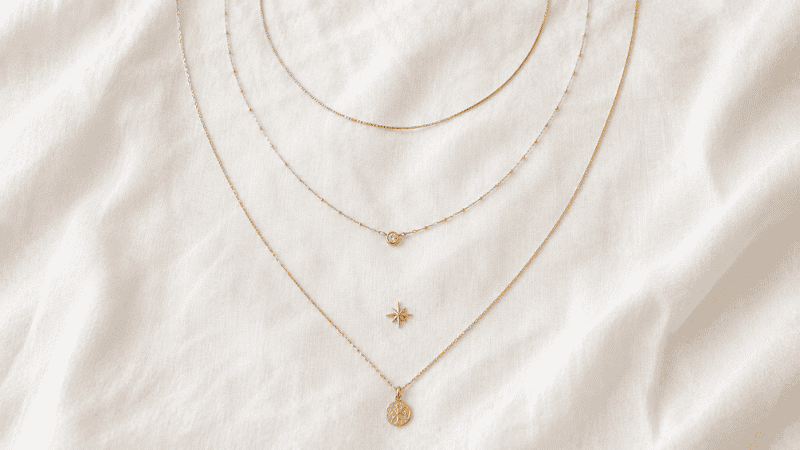
Understanding how different lengths fall on the body is what makes stacking feel intentional rather than accidental. These are approximate — your neckline and body proportions will shift them slightly, but the general picture holds.
14 to 16 inches — the collar zone. This sits close to the base of the neck, either against the throat or just at the collarbone. It’s the most intimate length and works beautifully as the shortest layer in a stack. A simple chain, a tiny pendant, or a delicate choker all work here.
17 to 18 inches — the collarbone. This is the most universally flattering length and the one most people already own. It sits right at or just below the collarbone, making it the natural anchor piece for most layered looks. A pendant at this length sits front and center, so this is a good spot for a piece you want to be seen.
19 to 20 inches — just below the collarbone. The transitional layer. This length adds depth without pulling the eye too far down. Works well for a slightly heavier chain or a small charm that needs a little breathing room below the collarbone piece.
22 to 24 inches — mid-chest. The longest layer in most stacks. This length grounds everything above it and is the best place for a meaningful pendant — something with a little weight, a personal charm, or a stone that you want to show off. The extra length creates a natural V-shape when paired with shorter pieces, which is flattering regardless of neckline.
The Beginner Stack: A Formula That Always Works
If you’re starting out or you want a reliable combination that works with almost everything, this is the stack to build:
A simple chain at 16 inches — no pendant, just texture. This sits close to the neck and creates a clean foundation without competing with anything else.
A pendant necklace at 18 inches. This is your focal piece. The pendant can be as simple or as personal as you want — a small geometric shape, an initial, a moon, a stone you love. Because it sits at the collarbone, it naturally draws the eye.
A slightly longer chain at 20 to 22 inches. This can have a small pendant or be chain-only. Its job is to anchor the stack visually and create length. A different chain style than the middle piece — maybe a curb chain if the middle is a delicate box chain, or a slightly chunkier link if everything else is fine — adds texture without adding noise.
Three pieces in three distinct lengths. That’s the whole formula.
How to Layer Necklaces Without Tangling
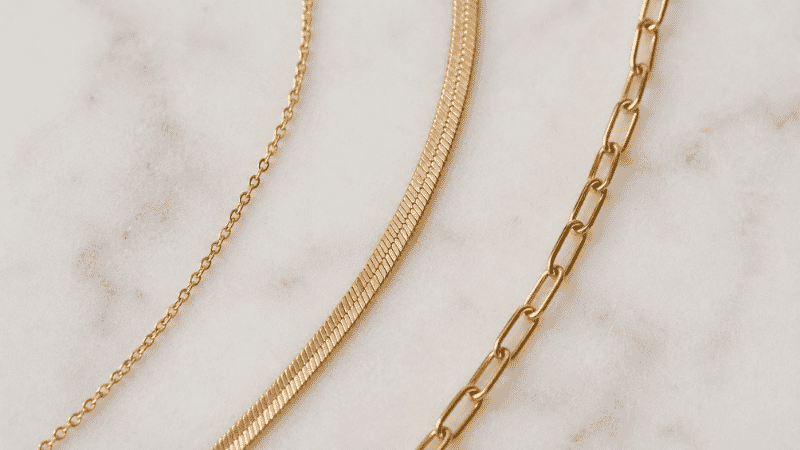
Lengths help, but the type of chain you choose matters just as much for tangle prevention. Some chains are significantly more prone to knotting than others.
Chains that tangle easily: Thin cable chains and fine rope chains are the most common culprits. Their small, uniform links catch on each other at the slightest overlap. If you love these styles — and they are beautiful — pair them with chains that have a very different structure so they can’t interlock.
Chains that resist tangling: Herringbone, snake, and box chains lie flat and don’t grab onto other chains easily. Paperclip chains have distinctive links with enough space between them that other pieces can’t hook in. Curb chains, with their flat, interlocking links, behave well alongside fine chains because their structure is too different to mesh.
The order you put them on matters too. Start with the thinnest, most delicate chain first — against your skin. Then add heavier pieces over the top. If you do it the other way around, a chunky piece can trap a delicate chain underneath and create both a tangle and an uncomfortable pressure point. Thin first, heavier last, always.
A necklace layering clasp is worth knowing about. This is a small connector that attaches to the clasps of multiple necklaces, holding them together at a single point at the back of your neck. It keeps the chains from migrating and crossing throughout the day. If you wear the same stack regularly, it’s one of the most practical accessories you can own.
Mixing Metals: The Old Rule Is Gone
For a long time, the conventional wisdom was to keep your metals consistent — all gold or all silver, never both. That’s no longer how people dress, and the look of intentionally mixed metals has become one of the most modern and wearable options in jewelry styling.
The key word is intentional. A mixed-metal stack that looks deliberate reads as stylish. One that looks accidental reads as careless. The difference is usually one piece.
The easiest way to make a mixed-metal stack look considered: use one piece that bridges the two metals. A necklace with both gold and silver elements — a two-tone chain, a pendant with a mixed-metal setting, or even a charm with accents in both — acts as a visual connector and makes the rest of the stack feel cohesive. Without that bridge piece, gold and silver can feel like they belong to two different outfits.
Another approach that works well: commit to one metal for the shorter layers and introduce the other at the longest layer. The visual separation keeps the mix from feeling random.
Matching the Stack to the Neckline

The neckline you’re wearing changes everything about which lengths make sense.
V-necks and open necklines give you the most canvas. Any combination of lengths works, and a longer pendant at 22 to 24 inches can follow the V and become part of the outfit rather than sitting on top of it.
Crew necks and round necklines work best with longer pieces — 18 inches and below can disappear under the fabric. Pieces at 20 inches and longer sit on top of the neckline and create a clean, intentional look.
High necks, turtlenecks, and mock necks are actually a great opportunity for layering that most people underuse. Because the neckline is filled, longer pieces at 22 to 26 inches drape over the fabric and look beautiful. Skip the shorter layers and let one or two longer pieces do all the work.
Square and boat necklines are the most forgiving. The wide horizontal opening naturally frames collarbone-length pieces (16 to 18 inches), and layering here creates a complementary horizontal effect.
Building the Stack: How to Know When to Stop
This is where most people struggle. There’s a moment in layering necklaces where the stack tips from curated to chaotic — and it’s easier to cross that line than it looks.
A few signals that you’ve hit the right number:
Each piece is still visible on its own. If you have to hunt for a specific necklace in the stack, it’s lost. When you can see every layer clearly, even if they overlap slightly at the sides, the stack is working.
The pieces have different personalities. If everything is the same weight, the same chain style, and the same size pendant, the layers blend into one visual block. Contrast — not clash — is what creates a stack that reads as layered rather than tangled.
You can still move comfortably. Layered necklaces that feel constantly present or keep sliding forward are too heavy or too many. The stack should be something you put on and forget.
For most everyday occasions, two to three pieces is the sweet spot. A fourth layer can work beautifully but requires more attention to balance. Five or more pieces is a commitment to a bolder look — it can be stunning but needs the outfit to match.
If Your Necklaces Do Tangle
It happens to everyone. When you end up with a knot, the worst thing you can do is pull. Tension makes knots tighter. Instead, lay the tangled chains flat on a hard surface — not soft fabric, which creates friction. Find the central knot and use a straight pin or needle to work into the center of it from the outside. Gentle, patient movements. The knot will loosen a loop at a time.
If you’re dealing with a very fine chain that has kinked or developed a tight twist rather than a knot, draping it loosely and letting it hang overnight often loosens it on its own.

FAQ
How many necklaces should you layer? Two to three is the most versatile range for everyday wear. It’s enough to create the layered effect without requiring a lot of styling effort. For bolder occasions or more creative looks, four or five can work beautifully — but each additional piece requires more attention to length separation and contrast.
How do you keep layered necklaces from tangling? Length separation is the most important factor — leave at least one to two inches between each piece. Beyond that: mix chain textures so pieces can’t interlock, put the thinnest chain on first, and consider a necklace layering clasp for stacks you wear regularly. Varying chain weight also helps; heavier pieces stay in place while lighter ones move more freely.
Can you layer necklaces of the same metal? Absolutely — it’s actually the easiest starting point. All-gold and all-silver stacks look clean and cohesive without requiring any thought about how the metals interact. The contrast comes from chain texture, length, and pendant style rather than metal color.
Can you layer necklaces with pendants? Yes, and it often looks better than chain-only stacks. The key is varying the size and weight of pendants so they don’t compete. A tiny pendant at the shortest layer, a medium pendant at the middle layer, and either a larger pendant or a plain chain at the longest layer creates a natural visual hierarchy.
What’s the best necklace length to start a stack with? 18 inches is the most universal starting point. It sits at the collarbone, which is the most flattering placement for most people, and works with the widest range of necklines. Build your other layers shorter and longer from there.
Layering necklaces is one of those things that looks complicated from the outside and feels straightforward once you’ve done it a few times. The logic is simple: space things out, mix your textures, put the lightest piece on first. The rest is just finding pieces you love and seeing how they talk to each other.
Start with two. See how they feel. Add a third when you’re ready. The stack that works is the one that feels like you — not the one that looks exactly like someone else’s.
Related reading:
- How to Match Jewelry to Your Neckline → [internal link]
- How to Mix Gold and Silver Jewelry Without It Looking Messy → [internal link]
- Best Everyday Necklaces for Women → [internal link]
Sources:
- Brilliant Earth — How to Layer Necklaces: A Complete Guide
- John Hardy — How to Master Layering Necklaces (February 2025)
- Lolabean Jewelry — How to Layer Necklaces Without Tangling (February 2026)
- All the Brilliants — How to Layer Necklaces Without Tangles