
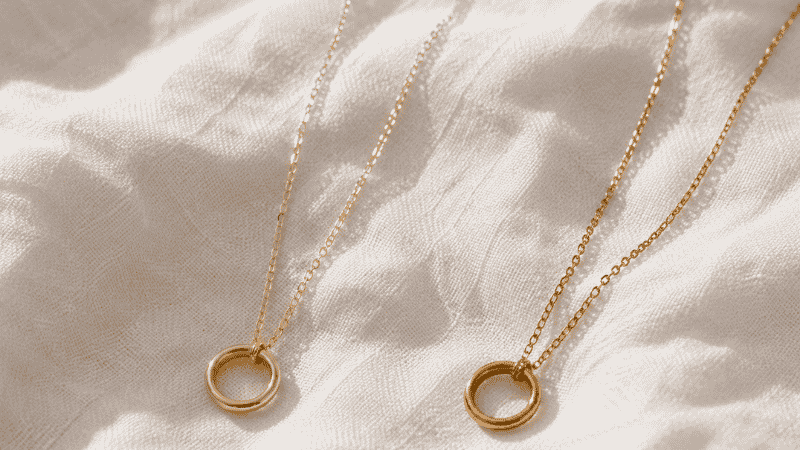
You’re standing in front of a jewelry display — or scrolling through one at midnight, which is when most of us make these decisions — and you’ve narrowed it down to two necklaces. Same design. Same brand. One says 14k, the other says 18k, and the 18k is noticeably more expensive. You’re not sure what you’d actually be paying for. Is it just a number? A status thing? Or does the difference between 14k and 18k gold actually change the way the piece looks, feels, and lasts?
It does — but maybe not in the way you’d expect. And once you understand what the numbers actually mean, the choice becomes a lot more personal and a lot less confusing.
Key Takeaways
- 14k gold is 58.3% pure gold; 18k gold is 75% pure gold — the rest is alloy metals in both cases
- 18k has a richer, warmer color; 14k is slightly lighter and more durable for everyday wear
- 14k costs less and resists scratches better; 18k is softer but more precious and less likely to cause skin reactions
- For daily-wear pieces like rings and bracelets, most jewelers recommend 14k; for necklaces and earrings, both work equally well
- Neither tarnishes — but both can scratch, and the higher the karat, the softer the metal
What the Karat Number Actually Means
Gold in its pure form — 24 karats — is too soft to hold its shape in jewelry. It bends, scratches, and dents from everyday contact in ways that would make wearing it impractical. So nearly all gold jewelry is an alloy: real gold mixed with other metals to give it strength and structure.
The karat number tells you how much of the alloy is actually gold. It’s measured in parts out of 24.
14k gold is 14 parts gold out of 24, which works out to 58.3% pure gold. The remaining 41.7% is a mixture of other metals — typically copper, silver, zinc, and sometimes nickel or palladium — depending on the jeweler and the specific color of gold being produced.
18k gold is 18 parts gold out of 24, or 75% pure gold. The remaining 25% is alloy. There’s less of it, which means the gold content is higher and the presence of other metals is lower.
Both are real gold. Both are solid. Neither is plated or coated. The difference is purely in the ratio — and that ratio affects color, durability, price, and how the piece interacts with your skin.
The Color Difference Between 14k and 18k Gold
This is the part most people don’t expect to be noticeable, but it genuinely is — especially in yellow gold.
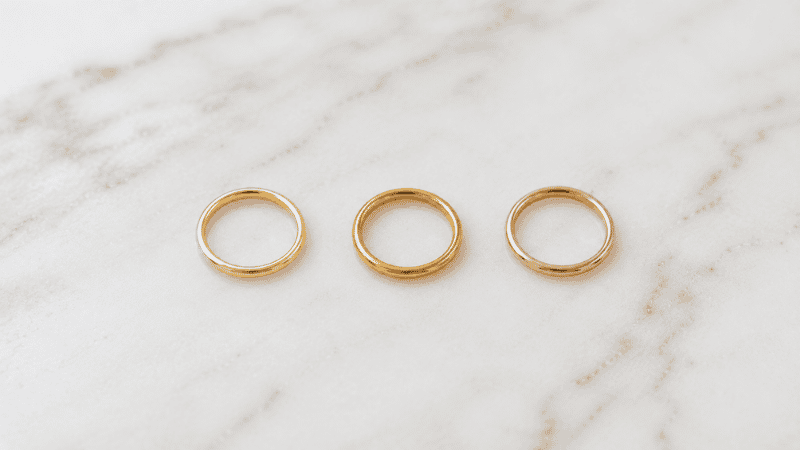
18k yellow gold has a deeper, warmer, more saturated color. It looks closer to what most people picture when they imagine “gold.” The higher pure gold content gives it that richness. If you’ve ever seen a piece of jewelry and thought it had a particularly luxurious, almost glowing quality to it, there’s a good chance it was 18k.
14k yellow gold is slightly lighter and cooler in tone. It’s still unmistakably gold — but the increased alloy content mutes the color a little. For many styles and aesthetics, this works beautifully. Dainty minimalist jewelry, in particular, often looks elegant in 14k precisely because the tone is softer and more wearable across different outfits.
In white gold, the difference in color is less significant because both are rhodium-plated to achieve that bright silver-white finish. The karat affects durability more than appearance here.
In rose gold, the copper in the alloy is what creates the pinkish tone. Because 14k rose gold has more alloy (and therefore more copper) than 18k, it tends to have a stronger, more pronounced rose color. 18k rose gold is subtler — a warmer blush rather than a true pink.
Durability: Which Gold Karat Scratches Less?
Here’s the answer that surprises most people: 14k is actually more durable than 18k.
The reason is counterintuitive at first — higher gold content means a softer metal. Pure gold is very soft. When you dilute it with harder alloy metals, the result is stronger and more scratch-resistant. 14k gold, with its higher alloy content, holds up better to daily friction than 18k.
This is why most jewelers recommend 14k for rings, especially rings worn every day, and for bracelets — pieces that experience constant contact with surfaces and fabrics. The same necklace worn daily will show fewer signs of wear in 14k than in 18k over the same period of time.
That said, “more durable” doesn’t mean 18k scratches easily. Both are solid gold and will last a lifetime with reasonable care. The difference in durability is meaningful for pieces worn in high-friction situations — not so much for earrings or a pendant that mostly just hangs and catches light.
Price: How Much More Does 18k Cost?
The price difference between 14k and 18k jewelry reflects the gold content directly. 18k contains more pure gold per gram, and gold is priced by weight and purity, so an 18k piece will consistently cost more than an identical 14k piece.
The premium varies depending on the piece’s weight and design, but a general rule of thumb is that 18k runs roughly 20 to 30 percent higher than 14k for comparable pieces. For a simple delicate necklace, that might be a difference of $50 to $150. For a heavier statement piece or a ring with significant gold weight, the gap can be $300 or more.
Whether the premium is worth it depends entirely on what you’re buying it for. If you’re building a foundational jewelry wardrobe — pieces you’ll wear constantly, every day, for years — 14k gives you more durability for the money. If you’re buying something for special occasions, as a meaningful gift, or you simply want the warmth and richness of higher gold content, 18k is worth the investment.
Which Is Better for Sensitive Skin?
This is a question that comes up often, and the answer is nuanced.
Pure gold is hypoallergenic — it doesn’t cause reactions. But the alloy metals mixed with gold sometimes do, particularly nickel, which is a common allergen. Because 18k gold has less alloy content overall, it has a lower concentration of potential allergens. People with sensitive skin or known metal allergies generally tolerate 18k better than 14k.
That said, not all 14k gold contains nickel — many jewelers now produce nickel-free 14k alloys, using silver, copper, and zinc instead. If you have sensitive skin and are drawn to 14k for its durability and price, it’s worth asking specifically whether the alloy is nickel-free. Most reputable jewelers can tell you.
For earrings in particular — where metal makes direct contact with pierced skin — this distinction matters most. If you’ve ever experienced redness or irritation from earrings that were otherwise good quality, the nickel content in the alloy is often the cause.
14k vs 18k for Everyday Wear: Which Should You Actually Choose?

Rather than a definitive answer, think of it as a decision framework — because the right choice genuinely depends on the piece and how you’ll wear it.
For rings worn daily: 14k. The extra durability makes a real difference for something that contacts surfaces constantly. A 14k ring will show scratches more slowly than an 18k ring worn in the same conditions.
For necklaces and pendants: Either works well. Necklaces don’t experience the same friction as rings, so the durability advantage of 14k matters less. If you love the richer color of 18k and the budget allows, a necklace is a great place to invest in the higher karat.
For earrings: 18k if you have sensitive ears. The lower alloy content reduces the risk of irritation for people prone to reactions. Otherwise, both work.
For a gift: 18k carries a certain weight — in feel and in meaning. There’s something about the higher gold content that makes a piece feel more considered, more precious. If you’re choosing a piece to mark a birthday, an anniversary, or a moment that matters, 18k is the choice that reflects that intention.
For building a jewelry wardrobe on a budget: 14k lets you buy more pieces for the same investment. A full 14k collection — a delicate necklace, simple studs, a thin ring — often costs less than a single 18k statement piece. Neither is the wrong approach; it depends on what you’re building toward.
How to Read the Hallmark Stamp
Every piece of solid gold jewelry should have a hallmark — a small stamp that tells you exactly what you’re working with. Knowing how to read it takes about thirty seconds and saves a lot of uncertainty.
14k gold is stamped “14k,” “14kt,” or “585” (reflecting the 58.5% gold content in European hallmarking systems).
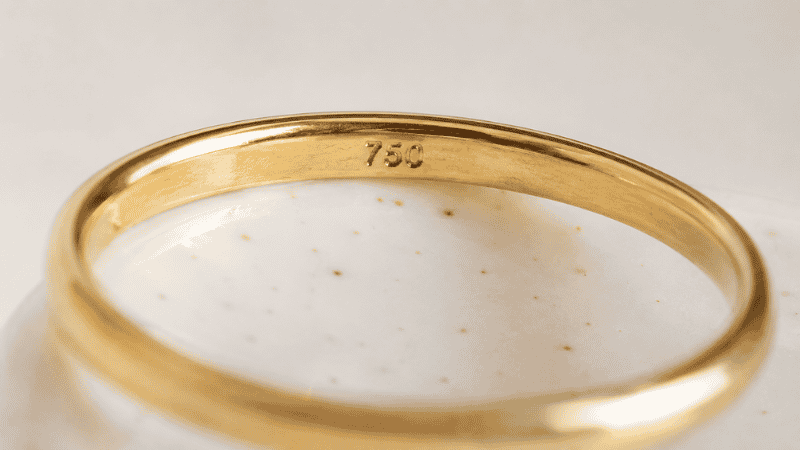
18k gold is stamped “18k,” “18kt,” or “750” (reflecting 75% gold content).
The stamp is usually found on the inside of a ring band, on a necklace clasp, or on the back of a pendant or earring post. If you’re buying second-hand or vintage and can’t find a stamp, a jeweler can test the piece to confirm its purity — it’s a standard and inexpensive service.
No stamp at all, especially on an inexpensive piece, is usually a sign that it’s plated rather than solid gold.

FAQ
Is 18k gold better than 14k? Neither is objectively better — they’re better for different things. 18k has more gold content, a richer color, and is gentler on sensitive skin. 14k is more durable, more scratch-resistant, and more affordable. For everyday rings and bracelets, 14k often makes more practical sense. For necklaces, gifts, and special pieces, 18k’s warmth and purity are worth the premium.
Does 14k gold tarnish? Solid gold — 14k or 18k — does not tarnish the way silver does. It’s naturally resistant to oxidation. However, it can look dull over time due to a buildup of skin oils, lotion, and grime. A gentle clean with warm water and mild dish soap restores the original shine.
Is 14k gold good enough for a gift? Absolutely. 14k is solid, real gold — not plated, not coated. It’s the standard for fine jewelry in the United States and is what most quality jewelry brands use for their everyday collections. The karat doesn’t determine whether a gift is meaningful; the choice behind it does.
Can you wear 14k gold in the shower? Technically, solid gold won’t be damaged by water. But soap residue and repeated moisture exposure cause gradual buildup that dulls the surface. Taking jewelry off before showering is a good habit regardless of karat — not to protect the metal, but to keep it looking its best.
What does “750” stamped on gold mean? 750 is the European hallmark for 18k gold, indicating the piece is 75% pure gold. Similarly, “585” indicates 14k gold (58.5% pure). These stamps mean exactly the same thing as “18k” and “14k” — just in a different notation system used widely in Europe and by international brands.
Once you understand what the numbers actually represent, the choice between 14k and 18k stops feeling like a test you might fail and starts feeling like a preference. Both are real gold. Both last. Both look beautiful in the right context.
The difference between them is a matter of priorities — color versus durability, purity versus practicality, investment versus everyday wearability. Neither answer is wrong. It’s just about knowing what you’re choosing and why.
Related reading:
- Does Gold Plated Jewelry Tarnish? Here’s the Honest Answer → [internal link]
- How to Clean Gold Jewelry at Home (Without Damaging It) → [internal link]
- Best Everyday Necklaces for Women → [internal link]
Sources:
- Costco Jewelry Buying Guide — Precious Metals (14k and 18k gold education)
- 1stDibs Expert Q&A — What is the difference between 14k and 18k gold? (August 2024)
- 1stDibs Expert Q&A — Is 14K gold good for earrings? (November 2023)
- 1stDibs Expert Q&A — What karat gold is best for earrings? (February 2021)