

Most people buy jewelry the wrong way. Not wrong in an obvious sense — they’re not buying bad pieces or making expensive mistakes. Wrong in a quieter way: they buy what catches their eye in the moment, bring it home, and then discover it sits in the jewelry box more often than it sits on them.
It doesn’t quite work with how they actually dress. It’s a slightly off metal tone. It’s beautiful but somehow not quite them. The purchase made sense in the store or at checkout, and now it doesn’t quite make sense anywhere.
Learning how to choose jewelry isn’t about developing some refined aesthetic or memorizing rules. It’s about understanding a few simple things — about yourself, about how you live, about what you’re actually drawn to versus what just photographs well — so that what you buy gets worn. This guide walks through all of it: from reading your own undertones to matching jewelry to your lifestyle, from understanding materials to building a collection that grows with you rather than beside you.
Key Takeaways
- The most important factor in choosing jewelry isn’t style — it’s wearability. A piece you’ll actually reach for daily is worth more than one that’s objectively beautiful but rarely worn
- Skin undertone (warm, cool, or neutral) determines which metal tones flatter your complexion most naturally — this one insight changes how everything looks on you
- Material quality matters more than price: 14k gold, sterling silver, and gold vermeil over sterling are the most reliable options at accessible price points
- Start with one or two foundational pieces in your metal of choice, then build outward — a full collection built this way feels cohesive rather than random
- For gifting: the most important thing to observe is what the person already wears, not what you think they’d like
Start Here: What Do You Actually Wear?
Before any other consideration, the most useful question when learning how to choose jewelry is the simplest one: what do you already reach for?
If you have jewelry and some of it gets worn every day while other pieces sit untouched, pay attention to the pattern. The pieces that make it onto your body without much thought — those are telling you something about your actual preferences, not your aspirational ones. The pieces that sit in the box are telling you something too.
Most people who feel like they “can’t find jewelry that works” have a specific unconscious preference they’ve never fully named. They reach for minimal over statement, or delicate over bold, or warm tones over cool ones. Once you identify that pattern, choosing jewelry stops being a guessing game and starts being a conversation with your own instincts.
If you’re starting with no existing jewelry collection at all, that’s actually freeing. You get to build from scratch, intentionally, rather than around a collection of random purchases.
How to Choose Jewelry for Your Skin Tone
This is the insight that changes everything — and it’s simpler than most guides make it sound.
Your skin has an undertone beneath its surface color. That undertone is either warm (yellow, peachy, golden), cool (pink, red, bluish), or neutral (a balance of both). Your surface skin color — how light or dark it is — matters much less than your undertone when it comes to jewelry. A person with dark skin can have cool undertones; a person with light skin can have warm ones.
How to find your undertone: Look at the veins on the inside of your wrist in natural daylight. If they look greenish, your undertone is warm. If they look blue or purple, your undertone is cool. If you genuinely can’t tell — they look both, or neither — your undertone is neutral.
Another test: think about whether you tend to look better in white or off-white. Bright, crisp white generally flatters cool undertones; cream or ivory flatters warm ones.
What this means for metal choice:
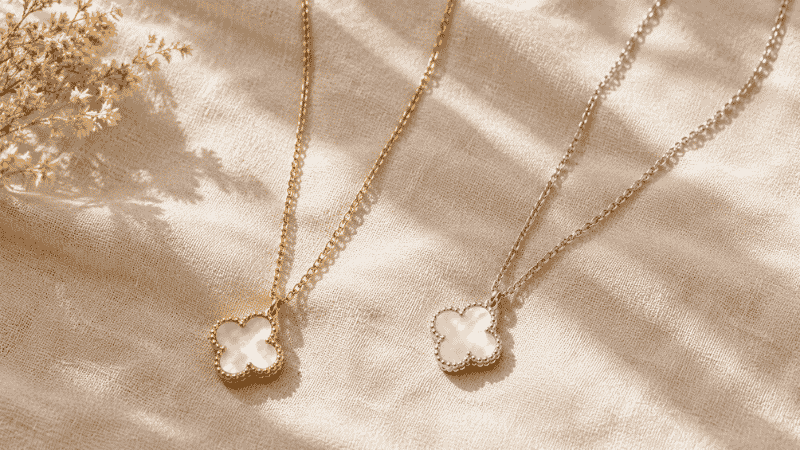
Warm undertones are flattered by yellow gold, rose gold, and copper tones. These metals reflect the warmth already in your skin and give you a glow that silver tones simply don’t. If you’ve ever tried on a silver necklace and felt it looked slightly cold or harsh against your complexion, warm undertone is likely why.
Cool undertones look stunning in silver, white gold, and platinum. These metals bring clarity and brightness to cool skin in a way that yellow gold can sometimes fight against. If gold has ever felt too heavy or too warm on you, your undertones may be leaning cool.
Neutral undertones are the most flexible. Both gold and silver work, and mixed-metal styling — wearing both simultaneously — comes naturally. If you’ve never had strong feelings about which metal looks better on you, this is probably why.
How to Choose Jewelry for Your Face Shape
Face shape matters most for earrings, moderately for necklace length, and less for everything else. The basic principle: contrast tends to flatter. A rounder face shape is balanced by longer, more vertical earrings. A longer, more angular face shape is softened by rounder, shorter earrings.
Round face: Long drop earrings, oval shapes, and angular designs create the appearance of length. Avoid very round, large hoops that mirror and emphasize the roundness.
Oval face: The most balanced proportions — almost any earring style works. This is the face shape that can wear statement pieces without careful calculation.
Square or angular face: Soft, rounded earrings — hoops, teardrop shapes, curved designs — soften strong jawlines beautifully. Avoid geometric, very angular pieces that emphasize the angles already there.
Heart shape (wider forehead, narrower chin): Wider earrings that sit at the jaw level — chandelier styles, wider hoops — balance the proportions. Avoid very long, narrow drops that emphasize the narrow chin.
Long or oblong face: Wider earrings and shorter drops create the appearance of width. Large hoops and button earrings work particularly well.
For necklaces: shorter lengths (14 to 16 inches) draw the eye upward and work well for longer necks and face shapes. Longer necklaces (18 to 22 inches) elongate shorter necks and rounder face shapes.
How to Choose Jewelry Materials: What’s Actually Worth Buying
This is where most jewelry guides either skip important details or get too technical. Here’s a plain-language version of what matters.
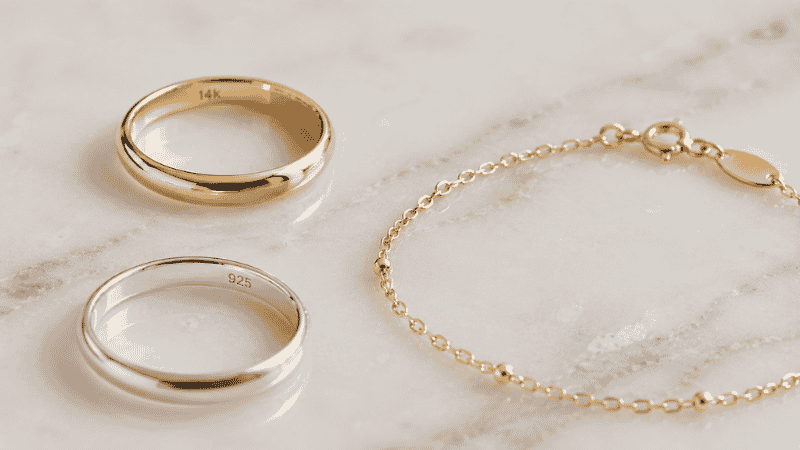
Solid gold (10k, 14k, 18k) is the most durable option and the only one that truly never tarnishes. 14k is the sweet spot for everyday wear — durable enough to handle daily contact, pure enough to be hypoallergenic for most people, and available at accessible price points for simple pieces. 18k has a richer, warmer color but is softer and scratches more easily. Worth it for necklaces and earrings; 14k makes more sense for rings and bracelets that experience daily friction.
Gold vermeil (pronounced ver-MAY) is thick gold plating — at least 2.5 microns — over sterling silver. It’s the best alternative to solid gold at a lower price point. With proper care, it lasts years rather than months. Look for pieces specifically labeled “gold vermeil” rather than just “gold plated.”
Sterling silver (925) is real silver — 92.5% pure, with copper added for strength. It tarnishes over time but polishes back easily. Durable, beautiful, and accessible. The hallmark to look for is “925” stamped on the piece.
Gold-filled is a layer of gold mechanically bonded to a base metal — much thicker than standard plating and significantly more durable. A good middle-ground option that’s often overlooked.
Standard gold plating over brass is the least durable option. It looks identical to everything else out of the box but wears through quickly with regular contact. Fine for occasional-wear pieces; not ideal for daily wear.
What to avoid: pieces with no material information, descriptions like “gold tone” with no further detail, and anything that lists “alloy” as the only material. These are almost always brass or unknown base metals with minimal plating.
How to Choose Jewelry for Your Lifestyle
The most beautiful piece in the wrong context becomes the most unworn piece in your collection.
If you work with your hands — in a kitchen, a lab, a garden, anywhere with physical contact — rings and bracelets get in the way and wear down faster. The most practical choices for active lifestyles are stud earrings (they stay put and don’t catch on anything), simple chain necklaces, and minimal bracelets you can take off quickly.
If you work in a professional environment — an office, client-facing role, or formal setting — the guideline most stylists follow is one or two well-chosen pieces rather than a full stack. A quality pair of studs and a simple necklace. A single bracelet. Restraint that looks intentional, not bare.
If your style is casual and expressive — creative fields, relaxed environments, personal style that leans expressive — you have the most freedom. Layered necklaces, stacked rings, mixed metals: all of this works when the context allows for it.
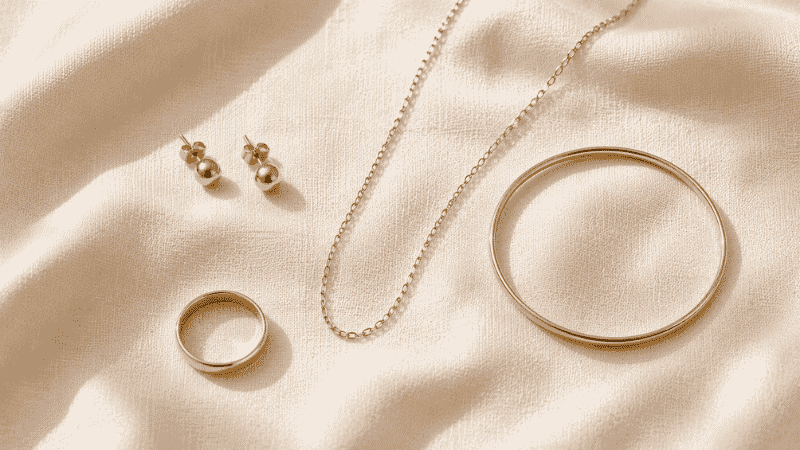
If you’re building a capsule jewelry wardrobe — a small set of pieces that work with everything — the formula is simple. One pair of small studs in your metal of choice. One delicate chain necklace at a flattering length. One simple ring, if you wear rings. One bracelet or bangle if you’re a wrist person. Everything else is optional. This four-piece foundation works for almost every occasion and outfit, can be built incrementally, and lasts indefinitely if the materials are right.
How to Choose Jewelry as a Gift

Buying jewelry for someone else is harder than buying for yourself — you’re choosing based on your interpretation of their preferences rather than your direct experience of them.
The single most useful thing you can do is observe, not guess. What does the person actually wear? What metal tone appears in their existing jewelry? Do they prefer minimal or expressive? Do they wear necklaces at all, or do they always go for earrings?
If you know their metal preference and their style register (minimal vs. bold), you’ve eliminated most of the risk. A piece in the right metal that fits their aesthetic will almost always land, even if the specific design isn’t something they’d have chosen themselves.
If you’re genuinely uncertain, personalized pieces are the safest investment in meaningfulness. A birthstone, an initial, something with a date or detail only they’d recognize — these succeed because they feel chosen rather than purchased, regardless of the style.
The other reliable option: something in a category they clearly love, in a slightly better quality than what they already own. Better studs to replace the ones they wear every day. A finer chain than the one that’s become their default. An upgrade feels considerate without requiring you to invent a new taste for them.
When You Only Have 10 Minutes to Decide
You’re in a store. Or at the final step of an online checkout. You like the piece, you’re not sure, and you need to make a call.
Ask yourself three questions in order:
Is this my metal tone? If it’s the wrong metal for your undertone, it will look off every time you wear it regardless of how much you love the design.
Is this my scale? Delicate pieces on people who prefer bold looks lost. Statement pieces on people who prefer minimal look costume-y. Match the scale of the piece to the scale of what you already wear.
Can I wear this with three things I own right now? If you can name three specific outfits where this works, it’s a genuine addition to your wardrobe. If you’re imagining a future purchase or a hypothetical outfit, wait.
Two yeses out of three is probably fine. One yes is a pass.
FAQ
How do I choose jewelry that suits my style? Start with what you already wear and love, not what you aspire to wear. Your instincts about what feels comfortable and natural are more reliable than trend research. Look at what pieces you reach for most often and identify what they have in common — that’s your actual style.
How do I know what metal suits me? Check your vein color in natural light: greenish veins suggest warm undertones (gold flatters you), blue-purple veins suggest cool undertones (silver and white gold flatter you), and mixed or unclear veins suggest neutral undertones (both work).
What jewelry should a beginner start with? One pair of small studs, one simple chain necklace, and one ring or bracelet if those categories suit your lifestyle. All in the same metal tone. This creates a cohesive foundation you can build on without anything feeling mismatched.
How do I choose jewelry for sensitive skin? Look for 14k or 18k solid gold, sterling silver (925), surgical-grade stainless steel, or titanium. Avoid pieces with no material information or those that list “alloy” as the primary metal — these often contain nickel, the most common jewelry allergen.
How do I choose jewelry for a gift when I don’t know their style? Observe what they already wear — the metal tone and the scale (minimal vs. bold) will tell you almost everything you need to know. When genuinely uncertain, a personalized piece (birthstone, initial, meaningful date) is the most reliably received option because it feels specifically chosen rather than generically purchased.
Choosing jewelry well is less about rules and more about attention — to what you’re drawn to, to what suits your coloring, to how you actually live. None of these things require expertise. They just require a little honesty about what you reach for, and what sits untouched.
The right piece of jewelry doesn’t announce itself. It just quietly becomes part of how you show up every day.
Related reading:
- How to Layer Necklaces: The Formula That Always Works → [internal link]
- 14k vs 18k Gold: What’s the Real Difference? → [internal link]
- Jewelry Gifts for Mom That She’ll Actually Wear → [internal link]
Sources:
- Cate & Chloe — How to Choose Jewelry Based on Your Skin Tone and Undertones (October 2024)
- Barbie’s Beauty Bits — How to Choose Handcrafted Jewelry That Complements Your Skin Tone (April 2026)
- The Vault Loans — How to Choose the Right Jewelry for Your Skin Tone (October 2025)
- Mvraki — Cool-Tone Jewelry: Metals & Gems for Your Skin Tone (October 2025)