
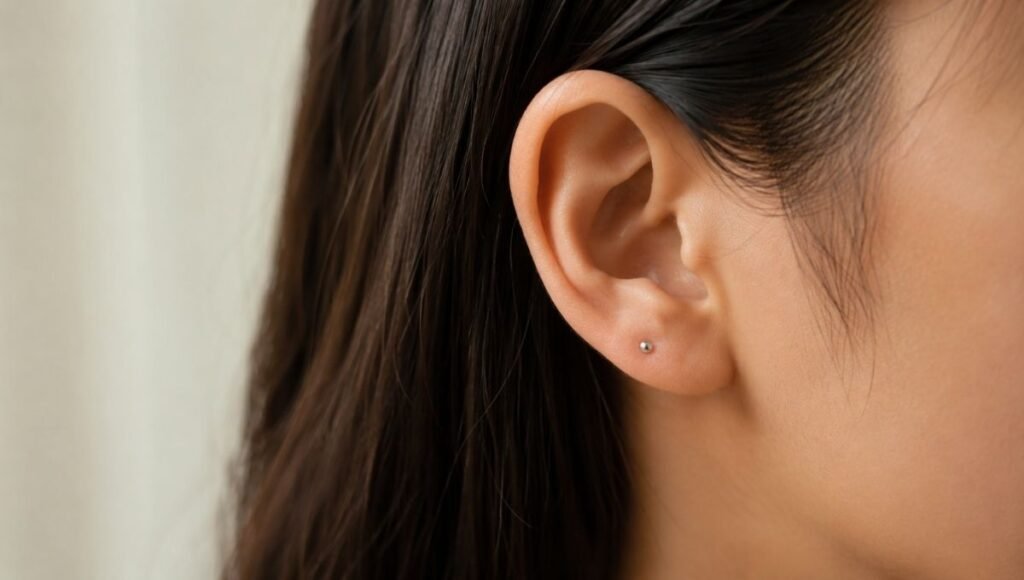
You bought the earrings because they said “hypoallergenic” right there on the packaging. You wore them for two hours and your earlobes were red and itching before lunch.
Or maybe it’s not a new pair — it’s a pair you’ve worn for years, and one day your ears just stopped tolerating them. Or you’ve given up on earrings almost entirely because every pair you try ends in irritation, and you’ve started to assume your ears are just impossible.
Here’s what’s actually happening: most of the vocabulary around “safe” earrings is marketing, not fact. “Hypoallergenic” has no legal definition. “Surgical steel” sounds reassuringly medical but can still contain nickel. “Nickel-free” claims are unregulated and frequently inaccurate. The people who make earrings are not required to prove any of these claims — they just have to make them.
This guide cuts through all of it. What actually causes earring reactions, which metals are genuinely safe (and why), what to look for on a label, and how to finally build an earring collection that works with your body rather than against it.
Key Takeaways
- Nickel is responsible for approximately 65% of all contact dermatitis cases related to jewelry — and it’s present in many earrings labeled “hypoallergenic” or “surgical steel”
- Implant-grade titanium (ASTM F-136) is the most reliably safe material for sensitive ears — less than 0.6% of people are allergic to it, according to Tini Lux’s research
- “Surgical steel” is not the same as implant-grade — surgical instruments are designed for surgical use, not for living inside the body, and most surgical steel grades contain nickel
- Solid 14k or 18k gold is safe for most sensitivities — the higher the karat, the less alloy content and the lower the reaction risk
- The earring post is what matters most — the decorative part of the earring barely contacts your piercing; the post and backing are what your body responds to
Why Your Ears React: The Real Cause
Before getting into materials, it helps to understand what’s actually happening when your ears react to earrings.
The most common cause is allergic contact dermatitis — an immune response to a specific substance, most often nickel. Your immune system identifies the metal as a threat, mounts a response, and produces the familiar symptoms: redness, itching, swelling, and sometimes a weeping rash at the contact point.
What makes nickel allergy particularly confusing is that it can develop over time. You might wear the same earrings for years with no problem, then suddenly your body has been sensitized enough that it reacts. Allergic reactions to earrings are usually caused by a nickel allergy, the most common metal allergy, which triggers contact dermatitis and can develop even after years of wearing the same earrings without problems. This is why “but I wore these for ages” is genuinely not a useful counterargument — sensitization is cumulative.
According to board-certified dermatologist Rajani Katta, MD, “When people are allergic to nickel, they’ll develop a rash right at the site of contact. With time, that rash may spread. A common scenario is when women wear earrings and start to develop a red itchy (and sometimes oozing) rash on their earlobes.”
Nickel is responsible for approximately 65% of all contact dermatitis cases related to jewelry. Even trace amounts in metal alloys can trigger reactions in sensitive individuals.
The important thing to understand: this is not a skin problem. It’s a metal problem. Switching to the right metal resolves reactions almost entirely for most people.
Why “Hypoallergenic” and “Surgical Steel” Don’t Mean What You Think
This is the most important thing to understand before you buy another pair of earrings.
“Hypoallergenic” is a marketing term with no legal definition. In the United States, no regulatory body oversees the use of this word on jewelry. Any brand can put “hypoallergenic” on any product without proving the claim. It means nothing — or rather, it means whatever the brand decides it means, which is often very little.
“Surgical steel” is not the same as implant-grade. Stainless steel is a mixture of iron with at least 10.5% chromium, and it also contains varying amounts of other elements such as nickel and molybdenum. Both chromium and nickel can cause skin allergies, but nickel is most often the problem. Surgical instruments — scalpels, clamps, retractors — are made of stainless steel because they’re cleaned and sterilized between uses. They’re not designed to live in contact with human tissue indefinitely. The standard for surgical steel is different from the standard for implants, and the grades commonly sold as “surgical steel” earrings often contain 8–12% nickel.
“Nickel-free” is frequently inaccurate. The term is not always strict. In many places, it can still mean trace amounts of nickel are present. European standards are stricter than American ones — in the EU, jewelry that contacts skin must contain less than 0.05 micrograms of nickel per square centimeter per week — but even this standard allows for some nickel. And in the US, the term is essentially unregulated.
What this means practically: if your ears are sensitive and you’ve been buying earrings based on “hypoallergenic” or “surgical steel” or “nickel-free” labels without checking the actual metal, you may have been buying the problem repeatedly without realizing it.
The Metals That Are Actually Safe for Sensitive Ears
The good news is that genuinely safe options exist at every price point and in every earring style. The key is knowing what to look for.
Implant-Grade Titanium: The Gold Standard
Implant-grade titanium (ASTM F136) is used in medical implants and is nickel-free, stable, and safe for long-term wear. This is titanium manufactured to standards set for medical implants — the same material used in surgical screws, hip replacements, and dental implants. It is, by design, intended to live inside the human body without causing reactions.
Titanium is approved by the Association of Professional Piercers (APP) if it is implant grade, medical grade, or commercially pure ASTM F-67 compliant. It is extremely lightweight and according to the APP is “ideal for people with concerns about nickel sensitivity.”
One important distinction: not all titanium earrings are implant-grade. Titanium-plated jewelry is dangerous for people with sensitive ears — it’s typically a thin titanium layer applied to a lower-cost metal such as nickel or brass. Once that coating wears off, you will be exposed to the underlying metals, which can irritate your skin. Look specifically for “implant-grade titanium,” “ASTM F-136 titanium,” or “commercially pure titanium” — not just “titanium.”
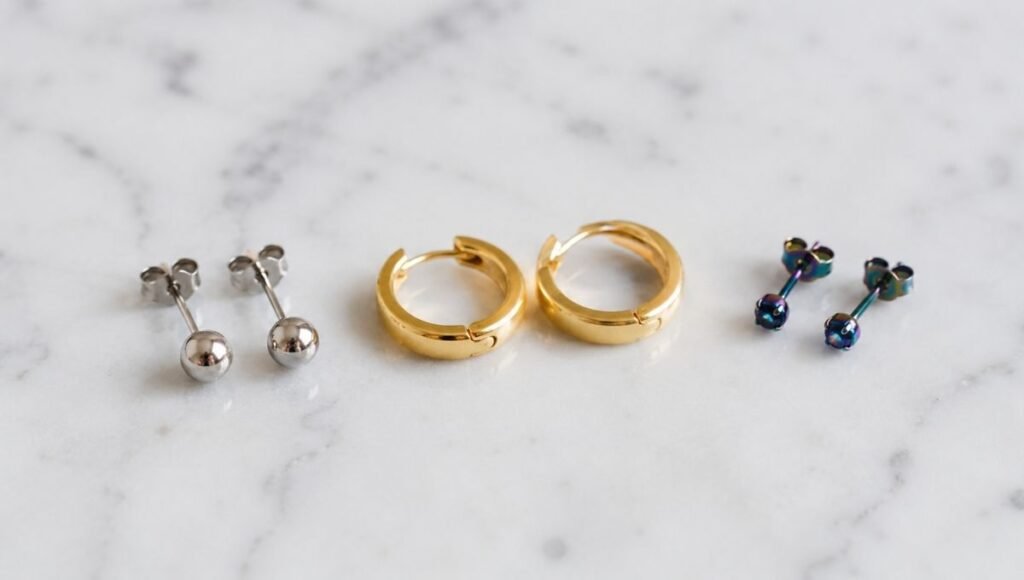
What titanium earrings look like: Silver-gray in their natural state, often available in anodized colors (soft gold tones, rose, blue) through a safe heat or electrical process that doesn’t add other metals. Lightweight, durable, and available in every earring style from simple studs to hoops to decorative drops.
Solid 14k and 18k Gold: Beautiful and Reliably Safe
Solid gold at 14k and above is safe for the vast majority of people with metal sensitivities. The key word is “solid.” When gold purity goes up — 14k, 18k, 24k — the percentage of allergy-causing metals goes down. Lower-karat gold contains more of certain metals, which often include nickel.
10k gold contains 41.7% alloy — a significant proportion of non-gold metals, which may include nickel depending on the alloy. 14k is 58.3% gold. 18k is 75% gold. At 18k, the alloy content is low enough that reactions are very rare for most nickel-sensitive people.
The important caveat: gold-plated, gold-filled, and gold vermeil earrings are not the same as solid gold. The surface is gold, but the post — the part that goes through your ear — may be a different metal. If you have sensitive ears, check specifically what the post is made of, not just the decorative portion.
Niobium: The Lesser-Known Safe Option
Niobium is approved by the APP in its natural, unalloyed state. It is a naturally inert metal that is non-reactive with the human body. Similar to titanium in its hypoallergenic properties, niobium is softer and more workable, which makes it commonly used for ear wires and hooks. It’s available in anodized colors and is an excellent option for people with sensitivities who want something other than titanium’s silver-gray tone.
Less widely available than titanium, but worth seeking out for wire-hook earrings in particular.
What to Avoid
Brass and copper: Both oxidize on contact with skin and sweat, producing the greenish marks most people have encountered. Both commonly contain or react with nickel.
“Alloy” or “metal” with no further specification: These descriptions almost always indicate brass or unknown metal compositions that may contain significant nickel.
White gold at lower karats: White gold achieves its color through alloys that often include nickel — particularly at 10k and 14k. If you want white-toned metal and have sensitive ears, implant-grade titanium or platinum are safer choices.
Sterling silver (925) for posts: Silver is generally safe as a material, but sterling silver posts can tarnish in contact with moisture from piercing channels. That tarnish can irritate sensitive tissue in ways that aren’t an allergy but still cause discomfort. Sterling is generally better for earring decorative elements than for posts directly in piercings.
The Post Is What Matters Most
This is the insight that most earring guides miss entirely — and it’s the most practically useful thing in this article.
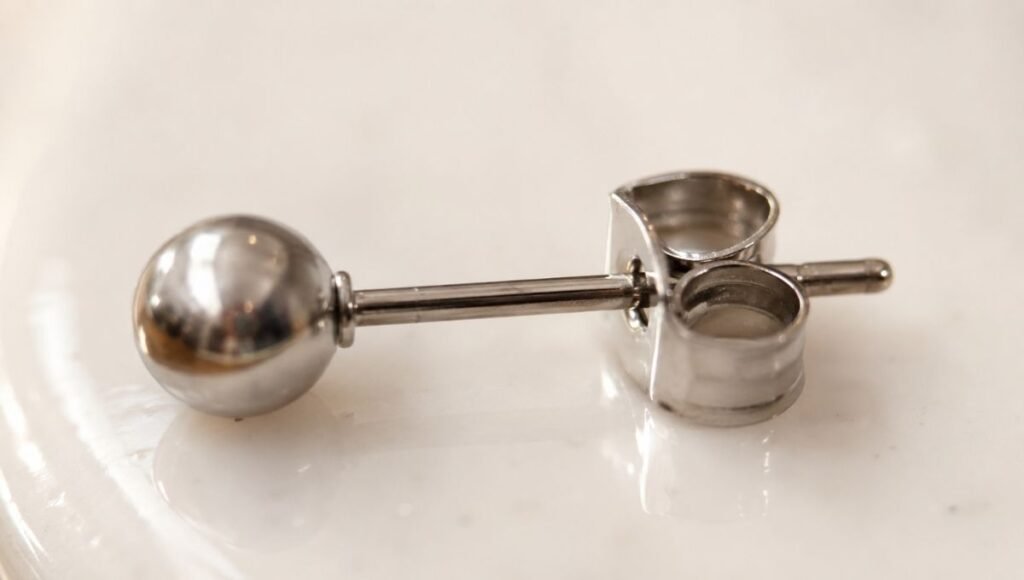
The decorative part of your earring barely contacts your ear. The post — the thin bar that passes through your piercing — is what your ear tissue is in contact with continuously. This is where reactions happen.
This means you can wear almost any style of earring if the post is made of the right material. A beautiful decorative earring with a brass front piece is safe if the post going through your ear is implant-grade titanium or solid gold. Conversely, an otherwise “safe” earring with a brass or unknown-alloy post will cause reactions regardless of what the decorative portion is made of.
When evaluating earrings for sensitive ears, the first question is: what is the post made of? If the brand can’t answer that question clearly and specifically, that’s your answer.
Reading Labels: What to Look For and What to Ignore
Worth trusting:
- “Implant-grade titanium (ASTM F-136)”
- “Commercially pure titanium (ASTM F-67)”
- “Solid 14k gold” or “solid 18k gold” with a hallmark stamp
- “Niobium, unalloyed”
- Brands that specify post material separately from decorative material
Not worth trusting on its own:
- “Hypoallergenic” without metal specification
- “Surgical steel” without grade specification
- “Nickel-free” without third-party verification
- “Safe for sensitive ears” without material details
- “Titanium” without grade or purity specification
Red flags:
- “Metal” or “alloy” as the only material listed
- No material information at all
- “Gold tone” or “silver tone” without stating the base metal
If You’ve Already Had a Reaction: What to Do
Remove the earrings immediately. Clean the area gently with mild soap and water and apply a cold compress to reduce inflammation. Most mild reactions resolve within a few days once the metal is removed.
Give the piercing time to fully settle before trying new earrings — at least two weeks for a mild reaction. When you reintroduce earrings, start with confirmed implant-grade titanium or solid gold and wear them for short periods before committing to all-day wear.
When to see a doctor:
See a doctor if you experience severe swelling, pus, fever, or spreading redness, as these symptoms indicate an infection rather than a simple allergic reaction and require professional treatment. An allergic reaction stays localized to the contact point. Spreading redness, warmth, and especially pus or fever mean something more serious is happening that needs medical attention, not a change of earring material.
Building an Earring Collection That Actually Works
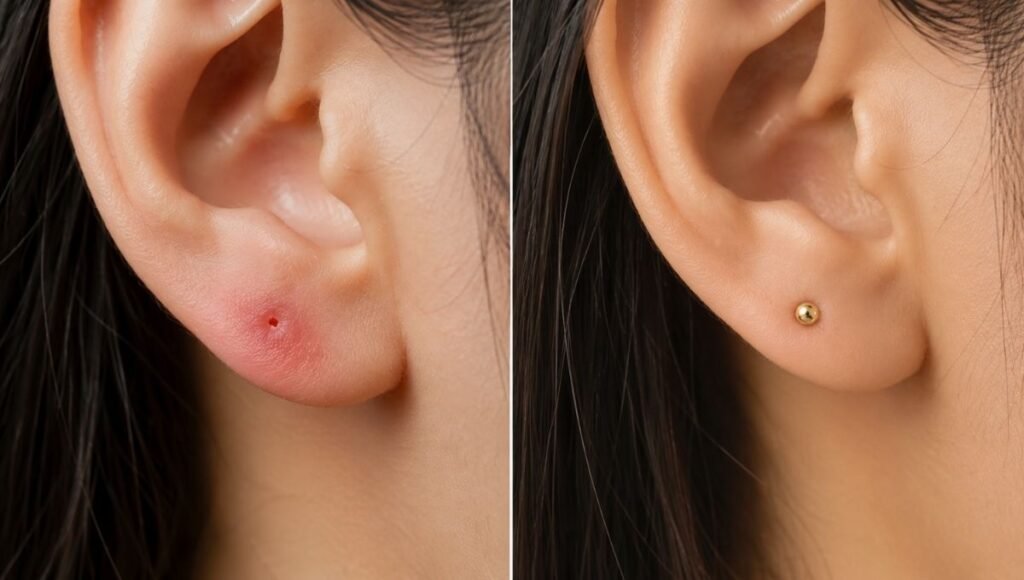
Once you’ve switched to a safe material and your ears have healed, building a collection is genuinely uncomplicated.
Start with one pair of implant-grade titanium studs in a simple shape — a small ball, a tiny disc, a plain post. These become your baseline: the pair you wear when everything else is in question, the pair you trust. From there, you can expand with other titanium pieces, solid gold studs and hoops, niobium wire earrings, and anything with verified safe posts.
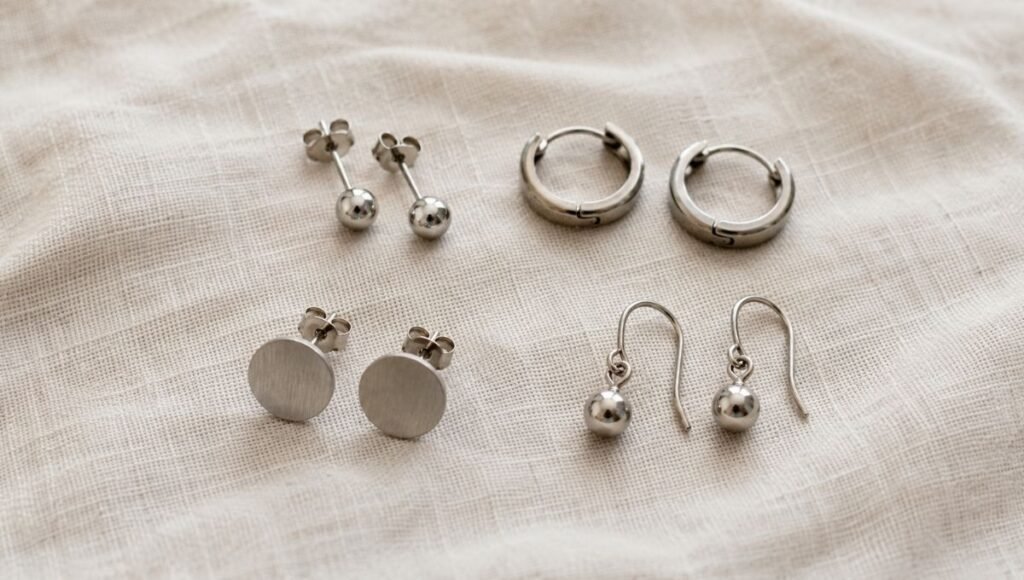
The practical reality is that most of the earring styles you love — huggies, hoops, drops, studs, ear cuffs — are available in titanium or solid gold. The material constraint doesn’t limit your options nearly as much as it might seem. It just narrows which specific products are worth buying.
FAQ
What earring metal is best for sensitive ears? Implant-grade titanium (ASTM F-136) is the safest and most widely recommended material for sensitive ears — less than 0.6% of people react to it. Solid 14k or 18k gold and unalloyed niobium are also safe for most sensitivities. The key is the post material — whatever passes through the piercing directly contacts your ear tissue.
Is surgical steel safe for sensitive ears? Not always. Surgical steel can contain 8–12% nickel depending on the grade. It’s designed for surgical instruments, not for long-term skin contact. “Surgical steel” earrings without a specific grade designation offer no guarantee of nickel content. For genuinely sensitive ears, implant-grade titanium is a safer choice.
Why do my ears react to earrings even when they say hypoallergenic? “Hypoallergenic” has no legal definition in the US and is an unregulated marketing term. A product labeled hypoallergenic can still contain nickel. Check the actual metal composition — specifically whether the post is implant-grade titanium, solid gold at 14k or above, or unalloyed niobium.
Can I wear gold earrings if I have sensitive ears? Solid 14k or 18k gold is safe for most people with nickel sensitivities. The higher the karat, the less alloy content. Avoid 10k gold, gold-plated, and gold-filled earrings where the post may be a different — and potentially reactive — metal.
What are the signs of an earring metal allergy vs an infection? A metal allergy causes redness, itching, and sometimes a rash at the contact point — it stays localized and improves when the earring is removed. An infection involves spreading redness, warmth, swelling, pus, and sometimes fever. Infections need medical treatment; allergies need a change of material.
Sensitive ears don’t have to mean a life without earrings. They just mean being more specific about what you put through them — and now you have the information to make those choices clearly, without relying on labels that were never designed to protect you.
The right earrings are out there. They just have a grade specification and a full metal composition listed.
Related reading:
- Types of Earrings: A Complete Guide to Every Style → [internal link]
- Jewelry Metals Guide: What Every Material Actually Means → [internal link]
Sources:
- American Academy of Dermatology Association — Nickel Allergy: How to Avoid Exposure and Reduce Symptoms (2024)
- Rajani Katta, MD — If You Are Allergic to Nickel, Try This Kind of Jewelry (November 2024)
- Association of Professional Piercers (APP) — Jewelry for Initial Piercings: Approved Materials
- Tini Lux — What Are the Best Metals for Sensitive Ears? (research and material specifications)
- Grayling Jewelry — Hypoallergenic Earrings: The Dermatologist-Backed Guide (December 2025)
- Blomdahl USA — The Safest Hypoallergenic Earrings Are Not Stainless Steel (May 2025)
- Cords Club — Allergic Reaction to Earrings (March 2026)