
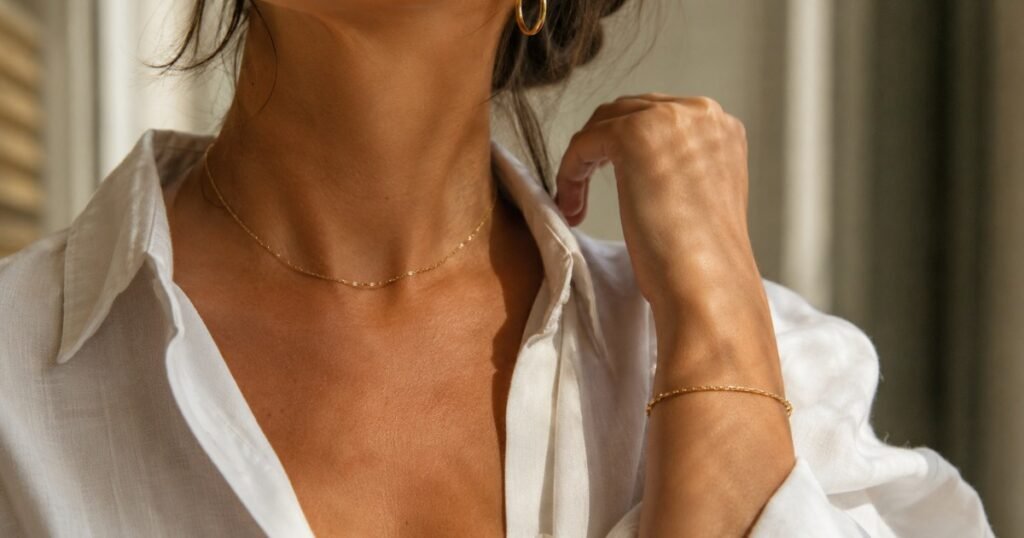
Some outfits come together effortlessly. Others can have perfectly good clothes and still feel a little flat.
The difference often has very little to do with the clothes themselves. More often, it’s the accessories—or how they’re being used. A pair of earrings that competes with the neckline. A necklace that’s the wrong length. Too many statement pieces fighting for attention, or no focal point at all.
Learning how to accessorize isn’t about adding more. It’s about knowing what each piece is supposed to do. Jewelry, bags, belts, and shoes all influence balance, proportion, and where the eye naturally goes. Once those details start working together, even the simplest outfit feels more intentional.
This guide covers the styling principles that apply to almost every wardrobe, then points you toward more specific outfit guides for casual looks, summer dressing, little black dresses, statement jewelry, and affordable luxury-inspired pieces.
Quick Start Guide
The easiest way to accessorize an outfit is to follow these five steps:
- Choose one focal accessory.
- Keep the remaining pieces simple.
- Match jewelry to your neckline and body proportions.
- Build around versatile everyday staples instead of trends.
- Adjust your accessories to suit the occasion.
In this guide, you’ll learn how to:
- Build a capsule jewelry collection
- Mix and layer jewelry naturally
- Style accessories for different outfits
- Choose better jewelry materials
- Avoid common accessorizing mistakes
- Explore dedicated styling guides for casual outfits, summer outfits, little black dresses, statement jewelry, and affordable luxury-inspired pieces
10-Second Outfit Check
Before you walk out the door, ask yourself these five questions:
✅ Do I have one clear focal point?
Whether it’s your earrings, necklace, bag, or shoes, let one element naturally draw attention.
✅ Is anything competing for attention?
If every accessory is bold, nothing stands out. Remove one piece if the outfit feels busy.
✅ Do my accessories match the mood of my outfit?
Relaxed outfits usually pair best with simple jewelry, while dressier looks can handle more statement pieces.
✅ Are my proportions balanced?
Choose jewelry that complements your neckline, body frame, and clothing silhouette rather than overpowering them.
✅ Would I still feel comfortable wearing this all day?
The best accessories should make you feel confident—not constantly adjusting or second-guessing your outfit.
If you answered “yes” to all five, your outfit is probably finished.
Why Accessories Can Completely Transform an Outfit
Accessories do more than complete an outfit—they shape how the entire look is perceived. Understanding a few simple styling principles makes it much easier to create outfits that feel balanced, polished, and effortless.
Why outfits sometimes feel unfinished
Clothing provides structure and coverage. Accessories provide personality and completion. An outfit without accessories is like a room with furniture but no lighting — technically functional, but missing the quality that makes it feel lived in and intentional.
The “unfinished” feeling most people recognize is usually the absence of one thing: a focal point. Something that gives the eye a clear place to land. Without it, the whole look reads as neutral even when the individual pieces are good. The outfit just exists rather than making a point.
Accessories create visual balance
Good accessorizing is largely about proportion and balance — giving visual weight to the right places to create a cohesive silhouette. A long necklace pulls the eye downward and creates length. A bold earring frames the face and draws attention upward. A structured bag adds visual weight at the hip that balances a fuller top.
These effects happen whether you’re conscious of them or not. The difference between someone who looks “put together” and someone who looks “dressed” is usually that the first person’s accessories are working with the proportions of their outfit, not against them or just alongside them.
The difference between decorating and styling
Decorating is adding accessories because they’re available. Styling is adding accessories because they serve a specific visual purpose in the context of that particular outfit.
A lot of accessorizing frustration comes from decorating — putting on several pieces that are each individually nice but aren’t doing coordinated work together. The result is more visual noise rather than more visual interest. Styling, by contrast, starts with the question: what does this outfit need? And then answers it with one or two deliberate choices.
The 3 Golden Rules of Accessorizing Without Looking Overdone
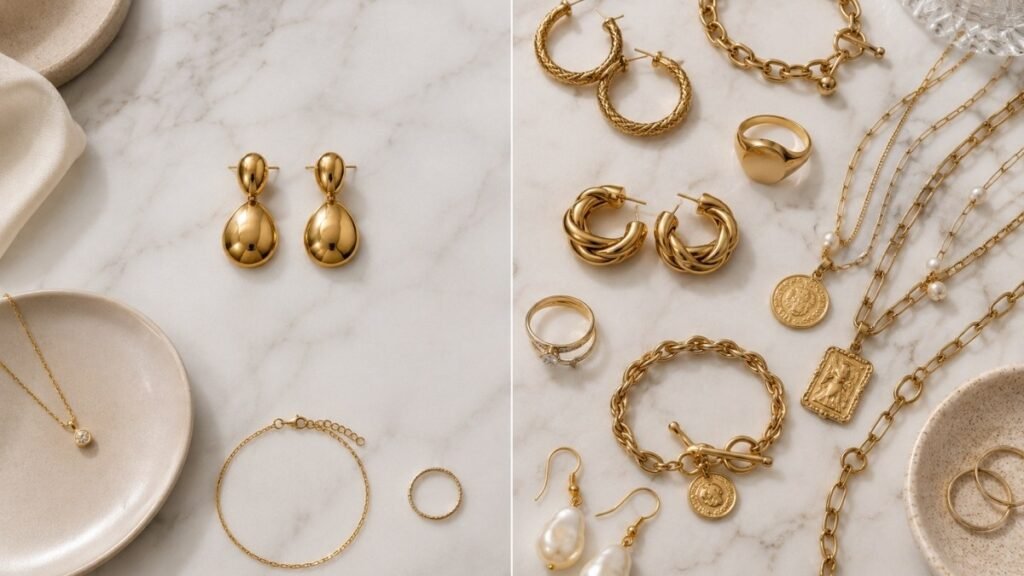
There’s a specific kind of self-consciousness that comes from wearing too many accessories at once. I’ve experienced it — leaving the house with three necklaces, two bracelets, and statement earrings, and spending the day feeling like I was wearing a costume rather than an outfit. The problem wasn’t any individual piece. It was the absence of a hierarchy. Everything was asking for attention simultaneously.
Choose one focal point
Every outfit, every day, should have one piece of jewelry or one accessory that’s doing the expressive work. One piece that makes the point. Everything else is supporting cast.
The focal point can be anything — a pair of bold earrings, a statement necklace, a distinctive ring, a textured bag. What matters is that it’s clearly the primary element. When there’s a clear focal point, the eye goes there immediately and the look reads as intentional. When everything is equally assertive, nothing reads as intentional.
Balance statement and minimal pieces
A statement piece needs quiet companions. Bold earrings pair with a simple chain or no necklace. A chunky necklace pairs with small studs. An interesting ring pairs with a clean bracelet situation or none at all.
This isn’t restraint for its own sake — it’s proportional thinking. The statement piece has presence because of the contrast around it. Remove the quiet companions and replace them with equally assertive pieces, and the original piece loses its impact. The contrast is what creates the effect.
Know when to stop
The practical test: once you’ve chosen your focal piece and its quiet companions, take one thing off. If the look improves or stays the same, you were wearing too much. If the look feels incomplete, you found the right number.
Most people need to hear this: you don’t need more accessories. You need the right balance. A single well-chosen piece consistently outperforms four mediocre choices assembled together.
Build an Everyday Jewelry Capsule Before Following Trends
I spent years buying jewelry reactively — a pair of earrings here, a necklace I loved in the moment there — and somehow never having what I needed when I got dressed. The pieces didn’t work together. They weren’t wrong; they just weren’t in conversation with each other.
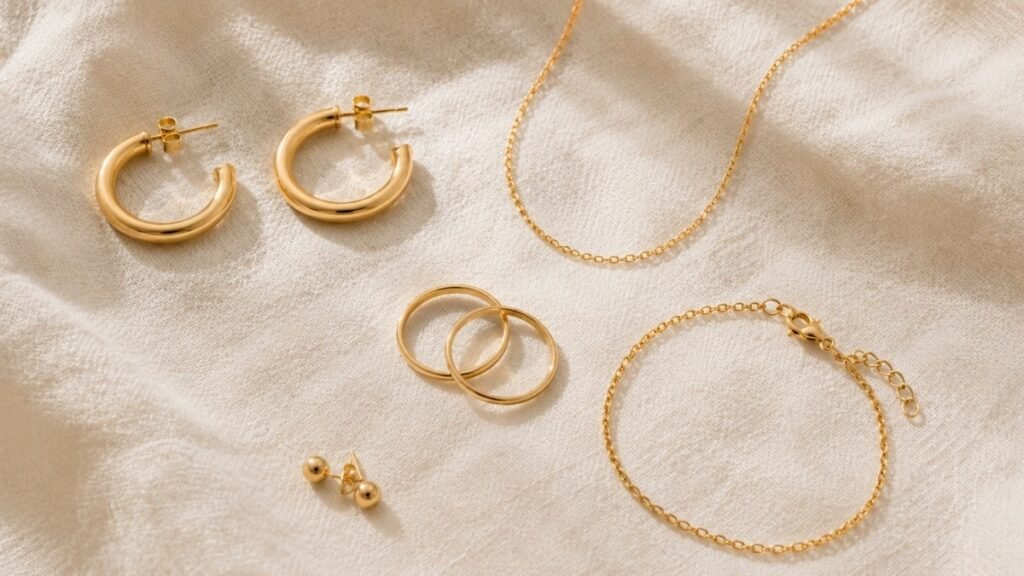
The shift happened when I stopped buying pieces and started building a capsule. Five pieces, all in the same metal, that work with each other and with most of my wardrobe. After that, getting dressed became dramatically easier, and I stopped buying things I didn’t actually need.
The five jewelry pieces everyone should own
Small hoop earrings (12–18mm): The most versatile earring available. Works with hair up or down, with every neckline, from casual to professional to evening. This is the earring you put in without thinking about it.
A delicate chain necklace (16–18 inches): The foundational necklace. Worn alone it completes a simple outfit; worn with other pieces it acts as the first layer of a stack. In your metal preference, with or without a small pendant.
Stackable rings: One or two thin bands that can be worn together or separately. They add something to even the simplest hand situation and layer easily with more distinctive pieces.
A simple bracelet or bangle: One piece at the wrist — a thin chain, a slim bangle — that works in all contexts without requiring thought. Not a statement; just a presence.
A pair of small studs: For the days when everything else feels like too much, or for a second piercing, or as the quiet companion to a more assertive earring.
Why capsule jewelry saves money
When your foundational pieces work together and with your wardrobe, you stop buying things reactively. Every new purchase has a clear context — it either fills a gap or adds something specific to the existing system. Without a capsule foundation, every purchase is a guess.
How one capsule creates dozens of outfits
The math works simply: five foundational pieces that work with each other and with most of your wardrobe create dozens of combinations, each of which reads differently depending on the outfit context. The same thin chain necklace looks one way on a white tee, another way on a silk dress, and another way layered with a pendant chain on a linen shirt. One piece, three contexts, three distinct looks.
Learn the Core Styling Techniques Every Outfit Uses
Layer necklaces
Layering two or three necklaces at different lengths — 16 inches, 20 inches, 24 inches — creates a statement look from individually simple pieces. The key is length separation: each chain needs at least two inches of vertical space to sit independently rather than tangling. Vary the chain styles slightly so each piece reads as distinct.
→ For bold necklaces and how to wear them with intention: [How to Wear Statement Jewelry Without Looking Overdressed]
Mix gold and silver
The modern approach: let one metal dominate and introduce the second as an accent. Two gold pieces and one silver reads as a deliberate mix. One gold and one silver reads as indecision. Or use a bridge piece — a two-tone chain or a mixed-metal setting — to connect both metals visually.
Balance proportions
Large-scale accessories work best with simple, quiet outfits. Small-scale accessories can work with more complex clothing. The principle is always the same: one thing provides the visual interest, everything else supports it. When the outfit is already complex — a pattern, a textured fabric, a structural silhouette — the accessories should be quieter. When the outfit is simple, the accessories can do more.
Repeat colors across accessories
Color cohesion across accessories — even subtle repetition — creates a sense that the outfit was considered as a whole. Gold hardware on a bag that echoes the gold in a necklace. A stone in a ring that pulls a color from the outfit. These connections don’t need to be obvious; they just need to exist.
Coordinate metals with outfit hardware
The metal on your accessories should be in conversation with the hardware on your clothes. Zipper pulls, button details, buckles — these have a metal tone that either harmonizes with or contradicts your jewelry. Gold jewelry with gold zipper hardware looks intentional. Gold jewelry with silver hardware looks like two separate decisions that happened to end up in the same outfit.
Accessorizing Different Outfit Types
Every outfit has its own styling challenges, but the goal stays the same: creating a look that feels balanced, intentional, and effortless. Here’s how those principles apply across different outfits, with dedicated guides if you’d like to explore each one in more detail.
Casual Everyday Outfits
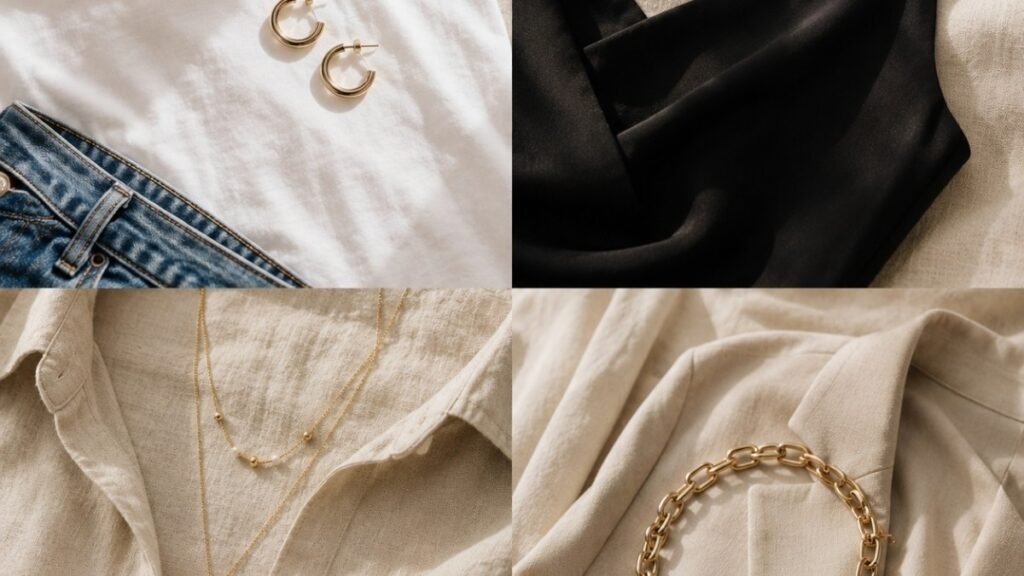
The casual outfit — white tee, jeans, knit sweater, sneakers — is both the easiest and the most misunderstood context for accessories. Easy because anything can work; misunderstood because people either do too much or too little.
The most reliable casual formula: one pair of small hoops or studs, one delicate chain necklace, one simple ring. Three pieces, minimal thought required, consistently looks finished. For slightly more personality: swap the delicate chain for a layered two-necklace look, or upgrade the studs to small drops. Still casual; more considered.
What casual outfits don’t need: statement earrings and a statement necklace simultaneously, heavy layered bracelets, or anything that reads as formal against the relaxed context of the clothes.
→ For the complete casual outfit jewelry guide: [Jewelry for Casual Outfits: How to Look Effortlessly Put-Together]
Summer Outfits
Summer’s lighter fabrics — linen, cotton voile, flowy dresses, tank tops — give jewelry more visibility because there’s more skin and less textile competing for attention. The exposed collarbone, the bare arm, the open neckline: these are all canvases that didn’t exist in heavier-weather dressing.
Summer accessories lean toward lightweight, color-friendly, and water-aware. Gold reads particularly warm against sun-kissed skin. Layered fine chains catch light beautifully against a simple sundress. Shell or stone elements add a tactile seasonal quality that metal-only pieces don’t quite achieve.
The summer priority: keep it light and let the skin do some of the work.
→ For the complete summer jewelry guide: [Jewelry for Summer Outfits: How to Look Effortlessly Finished]
Little Black Dresses
A little black dress is the outfit category where accessories have the most complete control over the final look. The dress itself says almost nothing specific about style, occasion, or personality. The jewelry says everything.
Pearl earrings and a simple gold chain on an LBD reads as elegant and classic. Oversized gold hoops and a layered chain reads as modern and confident. A single statement pendant on a delicate chain reads as minimalist. The same dress, three completely different statements — none of which came from the dress.
This makes the LBD one of the most useful pieces in any wardrobe, and understanding how to accessorize it unlocks its full range.
→ For the complete black dress jewelry guide: [Jewelry for Little Black Dress: The Styling Logic That Makes Everything Click]
Special Events and Statement Looks
Statement jewelry — oversized earrings, chunky chains, bold cuffs, dramatic rings — works at special events because the occasion provides the context that makes bold choices feel appropriate rather than excessive. A formal dinner, a wedding, a holiday party: these are moments when the visual register of the room is elevated, and your accessories can match it.
But statement jewelry also works in everyday contexts when the outfit is simple enough to provide a quiet backdrop. A chunky chain on a white tee is a statement look. The same chain on a patterned blouse is visual noise. The difference is the backdrop, not the piece.
The rule for statement jewelry at any occasion: one piece with real presence, everything else quiet. The statement needs contrast to function as a statement.
→ For the complete guide to wearing bold jewelry without overdoing it: [How to Wear Statement Jewelry Without Looking Overdressed]
Choosing Jewelry That Looks Expensive Without Spending a Fortune
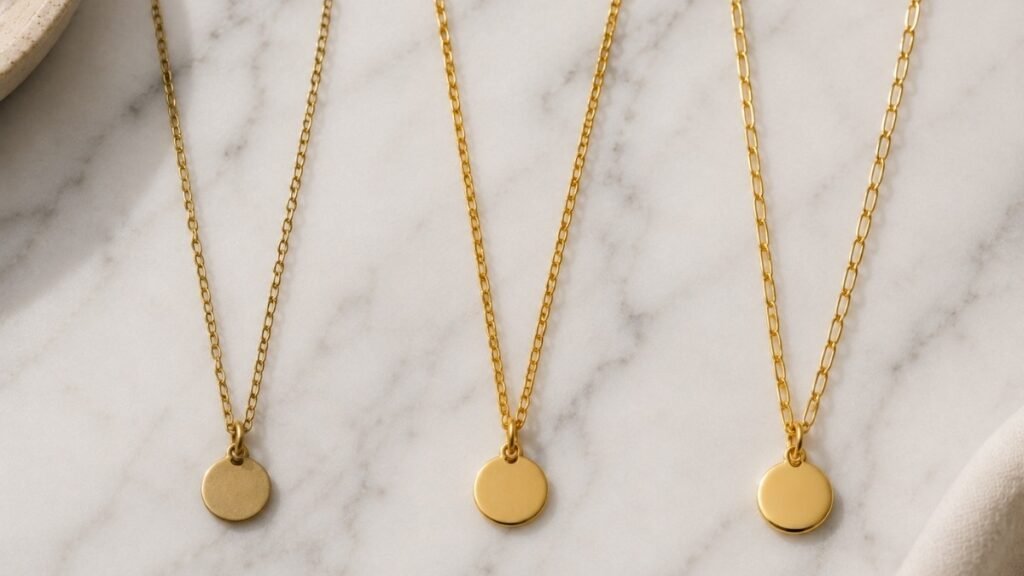
A few years ago I bought a pair of gold-toned drop earrings — no material specified, attractive price — and wore them twice before the plating started showing through and one of my earlobes developed the kind of redness that meant those earrings were done. The same thing happened with a necklace the following season. Two purchases, two disappointments, and I’d spent more in total than I would have on one piece in a genuinely lasting material.
Understanding materials is the single most practical thing you can learn about jewelry. Not because you need to spend more — but because spending differently gets you dramatically better results.
Gold Vermeil
Gold vermeil (pronounced “ver-MAY”) is real gold plating — minimum 2.5 microns thick — over a sterling silver base. The silver base is hypoallergenic for most people, and the gold layer is significantly thicker than standard plating. With reasonable care, vermeil pieces last considerably longer than base-metal plated jewelry and look the same coming out of the jewelry box as they do a year later.
Best for: necklaces and earrings, pieces worn regularly but not daily, gifting.
Gold Filled
Gold filled has a legally required gold content of at least 5% of total weight, mechanically bonded to the base metal rather than electroplated. The gold layer is substantially thicker than vermeil — dramatically thicker than standard plating — and the bonded construction means it doesn’t peel or separate the way plating does.
For pieces worn every single day — a ring, a bracelet, a necklace you never take off — gold filled is the most practical non-solid-gold option available.
Best for: daily-wear pieces, rings and bracelets that experience friction, pieces you want to wear indefinitely.
Sterling Silver
Sterling silver (925) is 92.5% pure silver, alloyed for strength. Beautiful, genuinely precious, and the right choice for anyone who prefers cooler metal tones. It tarnishes with air exposure — more care required than gold options — but polishes back to its original finish easily and lasts indefinitely.
Best for: cool-tone preferences, classic pieces, anyone who wants the real thing in the silver family.
What cheap alloys usually look like after a few wears
The signals: gold plating that shifts to a different color at wear points (the inside of a ring band, a necklace clasp, anywhere that experiences friction). A greenish tint on the skin at contact areas. Earring posts that cause redness within hours. Surface finish that looks slightly plasticky or uneven in certain light.
These are all signs of base-metal construction with minimal plating — not always the fault of the brand or the buyer, but worth recognizing so you can make different choices going forward.
→ For a look at luxury-inspired jewelry at accessible price points: [The Best Van Cleef Necklace Dupes That Actually Look the Part]
Common Accessorizing Mistakes Beginners Make
Buying too much before building a foundation. Trend pieces without foundational pieces means nothing works together consistently. The capsule comes first.
Wearing everything at once. Every piece you own, together, in the same outfit. The result is visual noise, not visual interest. One focal point, supporting pieces only.
Too many colors competing. Three differently-colored stones, two different metal tones, a patterned bag — each element is asking for attention independently. Pick a color story and stay in it.
Proportion imbalance. An oversized statement necklace on a very petite frame. A tiny delicate chain on a larger, more structured outfit. Scale the jewelry to the scale of the outfit and the wearer.
Ignoring the occasion. Statement jewelry to a quiet professional meeting. Formal pearl jewelry to a casual Saturday. The accessories should match the register of the context, not just the outfit.
Chasing trends without owning basics. A trendy statement piece with nothing foundational to anchor it. The trend piece looks great in isolation; there’s nothing in the wardrobe for it to work with. Trends layer on top of foundations — they don’t replace them.
Quick Outfit Styling Cheat Sheet
| Outfit | Jewelry | Shoes | Bag |
|---|---|---|---|
| White Tee + Jeans | Small gold hoops + thin chain | Sneakers or loafers | Simple crossbody |
| Knit Sweater | Coin pendant necklace + stud earrings | Loafers | Tote |
| Little Black Dress | Pearl earrings + simple gold bracelet | Heels | Small clutch |
| Linen Dress | Layered thin chains + small hoops | Sandals | Straw or raffia bag |
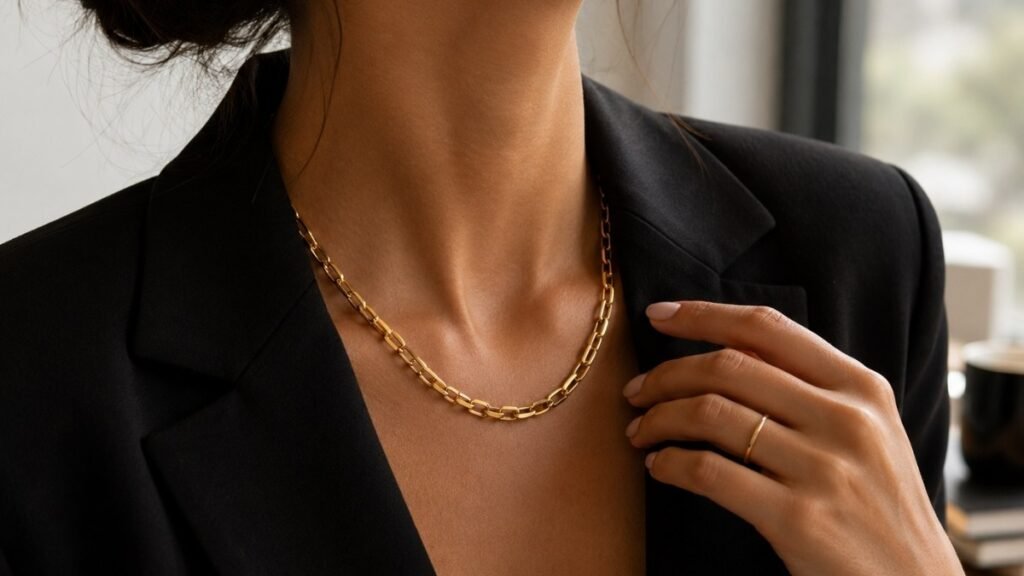
| Blazer + Tank | Chunky chain necklace + studs | Clean sneakers or mules | Structured shoulder bag |
| Sundress (floral) | Plain gold studs + thin chain | Flat sandals | Small woven bag |
| Slip Dress | One pendant necklace + no other necklace | Heeled sandals | Mini bag |
| Casual Denim Set | Gold hoops + stacked rings | White sneakers | Crossbody |
Where Should You Start?
If you take one thing from this guide, make it this: build the capsule first.
Five pieces in your metal preference that work with each other and with most of what you already wear. A pair of small hoops. A delicate chain. A simple ring or two. A slim bracelet. Small studs for backup. That’s it. Once those exist, every other decision — what to add, what to buy next, what to wear with which outfit — becomes dramatically easier because you have a foundation to work from.
Then, once the foundation is in place, go deeper on the specific outfit types that matter most to you. Casual outfits are where most people spend most of their time. Summer dressing has its own specific logic. The little black dress is worth understanding in detail. Statement jewelry is a learnable skill, not an innate confidence.
The guides below cover each of these in full. Use this page as your map; use them as your destinations.
The people who always seem to look effortlessly stylish aren’t the ones with the most jewelry. They’re the ones who know when to add something — and when to leave space for the outfit to breathe on its own.
FAQ
Q1. How do I accessorize an outfit without looking overdone?
Focus on one statement piece and keep the rest of your accessories simple. A balanced look almost always feels more polished than wearing several bold pieces at once.
Q2. What’s the easiest way to make a simple outfit look more stylish?
Start with one or two versatile jewelry pieces, such as hoop earrings or a delicate necklace, then add a structured bag or belt if needed. Small details often have a bigger impact than buying new clothes.
Q3. Is it okay to mix gold and silver jewelry?
Yes. Mixing metals is now considered a modern styling technique. The easiest approach is to let one metal dominate while using the other as an accent, or choose a piece that already combines both finishes.
Q4. How many accessories should I wear with one outfit?
There isn’t a fixed number, but most balanced outfits have one focal point supported by one or two subtle accessories. If every piece demands attention, the overall look can feel overwhelming.
Q5. How do I build a capsule jewelry collection?
Begin with a few timeless essentials that work with most of your wardrobe, such as small hoops, a delicate chain necklace, simple rings, stud earrings, and a slim bracelet. Once you have these basics, adding trend pieces becomes much easier.
Q6. What jewelry materials are best for everyday wear?
For frequent wear, look for durable materials such as Gold Vermeil, Gold Filled, or Sterling Silver. They generally last longer, feel more comfortable on sensitive skin, and offer better long-term value than inexpensive plated alloys.
Q7. Where can I learn how to accessorize different outfits?
This guide covers the core styling principles. If you’re looking for outfit-specific advice, explore our dedicated guides for casual outfits, summer outfits, little black dresses, statement jewelry, and affordable luxury-inspired styles.
✨ Aceloduo Styling Notes: The Thinking Behind This Guide
Learning how to accessorize isn’t about owning more jewelry—it’s about understanding how small details work together.
That’s why this guide focuses on timeless styling principles instead of fast-changing trends. Whether you’re getting dressed for work, a weekend brunch, or a special occasion, the goal is always the same: helping you feel confident without making your outfit feel overdone.
This guide is built around three simple ideas:
- ✨ Build a Strong Foundation — Start with versatile everyday jewelry before chasing trends.
- 💛 Create Balance — Let one piece stand out while the rest quietly support the look.
- 👗 Dress for Real Life — Style your accessories around your lifestyle, not just your wardrobe.
Because great style isn’t about following more rules.
It’s about making getting dressed feel easier every day.
Continue Building Your Jewelry Styling Skills
Accessorizing is a skill that grows over time. These guides explore each styling challenge in more detail:
[Jewelry for Casual Outfits: How to Look Effortlessly Put-Together] Learn how to elevate jeans, sweaters, sneakers, and everyday basics without looking overdressed.
[Jewelry for Summer Outfits: How to Look Effortlessly Finished] Discover lightweight jewelry combinations perfect for linen, dresses, sandals, and warm-weather outfits.
[Jewelry for Little Black Dress: The Styling Logic That Makes Everything Click] See how different jewelry styles completely transform the same black dress.
[How to Wear Statement Jewelry Without Looking Overdressed] Master bold earrings, chunky necklaces, oversized rings, and statement accessories without overwhelming your outfit.
[The Best Van Cleef Necklace Dupes That Actually Look the Part] Looking for timeless luxury-inspired jewelry at a more accessible price? Explore the best alternatives and what to look for before buying.
❤️ A Final Note
Great style isn’t about owning more—it’s about choosing better.
At Aceloduo, we’re here to help you discover timeless jewelry, smarter styling ideas, and practical advice you can use every day—not just for special occasions.
Our goal is simple: helping you make thoughtful choices, wear them with confidence, and enjoy getting dressed a little more every day.