
There’s a specific kind of getting dressed moment that most people know but don’t talk about enough. You’ve put on a perfectly good outfit — jeans, a clean white tee, maybe a linen shirt — and you look in the mirror and something is just… unfinished. Not wrong. Not bad. Just not quite done. Like the outfit is waiting for something.
That something is almost always jewelry.
Not a lot of it. Not something dramatic or complicated. Just the right piece, in the right place, for what you’re actually wearing. Casual clothes and jewelry have a specific relationship that’s different from formal or office dressing — the pieces that work with everyday outfits are the ones that enhance without announcing, that make a simple look feel intentional rather than accidental.
This guide is exactly about that relationship. Specific outfit scenarios, specific pieces, specific reasons why they work. Not rules to memorize but a way of seeing what casual clothes actually need — and what they don’t.
Key Takeaways
- Casual outfits don’t need less jewelry — they need the right jewelry, which is usually dainty, wearable, and in your metal preference
- The most useful piece for casual dressing is a thin chain necklace at 16–18 inches — it works with almost every neckline and requires no thought
- Small hoops (12–18mm) are the most versatile casual earring because they have presence without effort, and suit every hair situation from up to down
- One focal point per casual look is the sweet spot — a slightly more interesting piece with everything else quiet around it
- Casual dressing is where gold-filled and gold vermeil pieces earn their keep — the quality reads as elevated without the formality of fine jewelry
Why Jewelry Works Differently with Casual Clothes
Casual outfits have a different relationship with jewelry than formal or professional ones — and understanding this changes what you reach for.
A formal outfit already has structure, intention, and visual weight. The jewelry needs to match or complement that weight. A casual outfit — a t-shirt, jeans, a linen shirt — has almost none of that inherent structure. It’s a blank canvas. Which means jewelry has a different job: not to complement an existing statement, but to provide the finishing note that makes the whole look feel considered.
This is why the jewelry that works with casual clothes tends to be quieter rather than louder. A statement necklace on a casual outfit often overwhelms — the piece has more visual weight than the outfit can support. A thin gold chain on that same outfit lands exactly right because it adds elegance without adding drama. The outfit still reads as casual; it just reads as intentional casual rather than afterthought casual.
The other thing that’s different about casual dressing: you’re usually wearing these outfits more, in more contexts, with less preparation time. The jewelry you choose for casual outfits needs to be comfortable enough to forget, versatile enough to work across situations, and wearable enough to go on without a second thought at 7am.
Jewelry for Casual Outfits: The Classic Combinations
White T-Shirt or Plain Tee
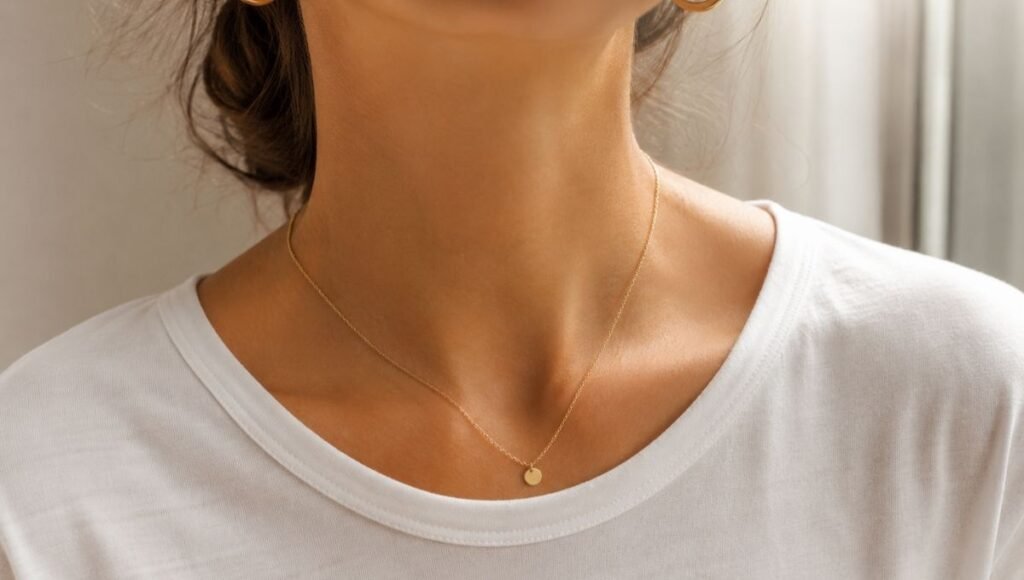
The white tee is the most neutral canvas in most people’s wardrobes — and it’s specifically generous to jewelry because the simplicity of the shirt gives any piece room to be seen.
What works: A thin gold chain at 16–18 inches is the most natural companion. At collarbone length, it sits exactly where the eye is drawn against a simple neckline. Add small gold studs or small hoops — 14mm or under — and you have a complete, effortless look that takes thirty seconds.
The elevated version: Layer two thin chains at different lengths (16 and 20 inches) with a tiny pendant on the longer one. The layered look reads as considered without being complicated, and the white tee background lets you actually see the chains rather than having them compete with pattern or detail.
What to avoid: Dramatic statement necklaces that are heavier than the shirt can hold. A chunky piece on a white tee looks like the jewelry is wearing you rather than the other way around.
Jeans — Any Cut
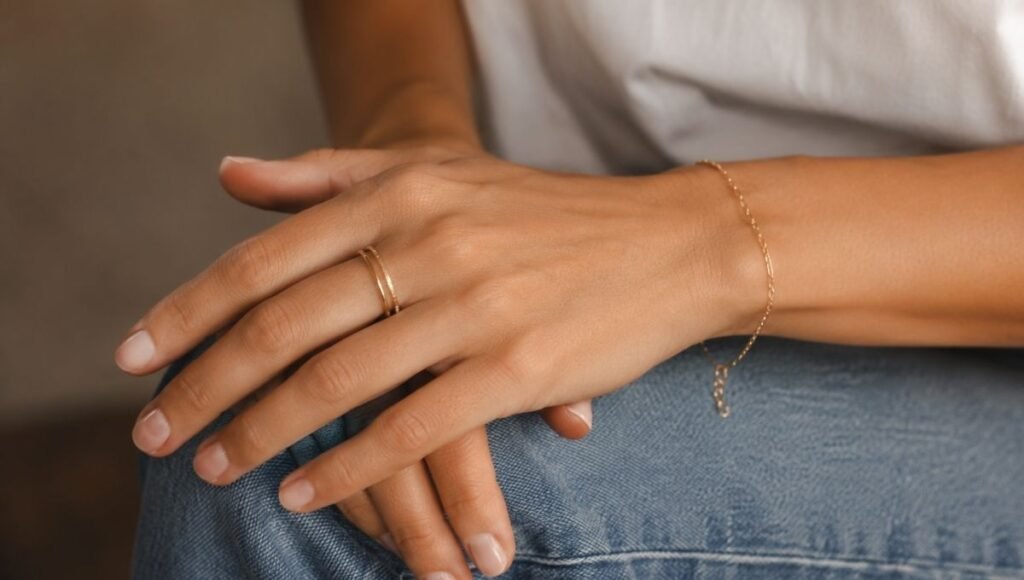
Denim is the most casual material and the most forgiving background for jewelry. Because jeans have their own texture and presence, they can hold slightly more jewelry than a simple tee.
What works: Rings show up particularly well with denim — the casual context means you can wear a slightly more interesting ring combination (two or three thin stacked bands, or one ring with a small stone) without it feeling excessive. A simple chain necklace and small earrings complete the picture without competing.
For higher-waisted jeans: A layered necklace stack works particularly well because the higher neckline of the jeans creates a natural frame for anything you’re wearing on your upper body — the eye moves naturally upward to where the jewelry is.
Bracelet moment: Denim is one of the few casual contexts where a slightly more expressive bracelet works — a chain bracelet with a small charm, a thin bangle with some texture — because the casualness of the jeans gives you permission to be a little more playful at the wrist.
Linen and Relaxed Shirts
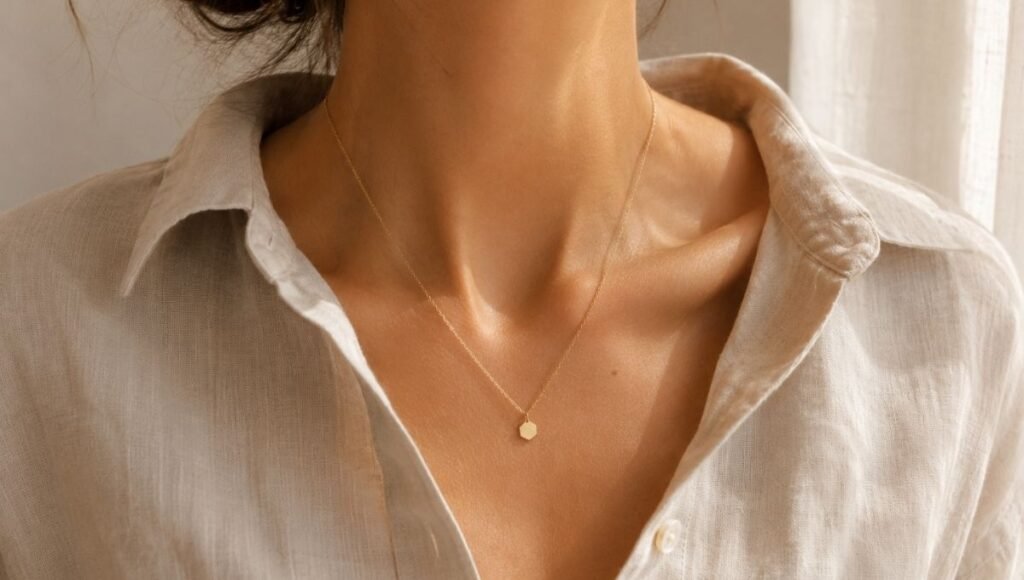
Linen has its own natural elegance — the texture is beautiful and the ease of the fabric reads as intentionally laid-back. The jewelry here should be in conversation with that ease rather than fighting it.
What works: A small pendant necklace — a tiny disc, a small geometric shape, a minimal initial — at collarbone length. The pendant gives the eye a place to land without over-complicating the clean quality of linen. Small gold studs are the ideal earring here; they’re quiet enough not to compete with the texture of the fabric.
For linen button-downs worn open: This neckline creates a natural V that’s begging for a necklace. A chain at 18–20 inches that falls just below the collarbone, following the open collar, looks completely natural and deliberate.
What linen doesn’t need: A lot of jewelry. The fabric itself has presence. One or two quiet pieces is enough — the outfit will do more work than you might expect.
Casual Dresses and Sundresses
Casual dresses — sundresses, linen dresses, jersey midi dresses — have a lightness to them that calls for jewelry in the same register.
For scoop or round necklines: A necklace at 18–20 inches that sits on the dress fabric (rather than against the skin) creates a deliberate, layered look. A pendant gives it a focal point.
For V-necklines: A necklace that follows the V, at around 18–22 inches, looks completely natural. The pendant should sit above the bottom of the V to look intentional rather than accidental.
For strapless or off-shoulder: This is when earrings become the primary jewelry choice. A small drop earring (under 2cm) or a pair of slightly larger hoops (18–25mm) frame the face beautifully when the collarbone is bare. Keep the neck clean — or add a very delicate chain — and let the earrings do the work.
For high-neck or turtleneck casual styles: Longer necklaces (20–24 inches) sit on top of the fabric and look beautiful. Alternatively, skip the necklace entirely and focus on earrings or rings.
Jewelry for Work Outfits: The Casual-Professional Register
Work outfits in most professional contexts today land in a middle register — not formal, but not purely casual either. The jewelry here needs to be polished without being serious, present without being distracting.
The safest foundation: A quality pair of small hoops or studs, a simple chain necklace, one clean ring. This combination works in virtually every professional context and takes the whole approach off the table — you don’t have to think about it.
For client-facing or formal meetings: One focal piece, everything else quiet. A slightly more interesting necklace (a pendant with a small stone, a slightly chunkier chain) paired with simple studs and minimal wrist jewelry. The focal piece signals that you got dressed intentionally; the quiet pieces show restraint.
For creative or relaxed work environments: More room to layer. Two necklace lengths, a ring stack, a bracelet alongside a watch. The key is still having a clear focal point so the look reads as curated rather than accumulated.
What to avoid at work: Anything that makes noise (bangles that clank, long earrings that brush your shoulders when you move), anything that requires adjustment throughout the day, anything so expressive that it becomes the primary thing people notice about you in a professional context.
The One-Piece Rule for Casual Dressing
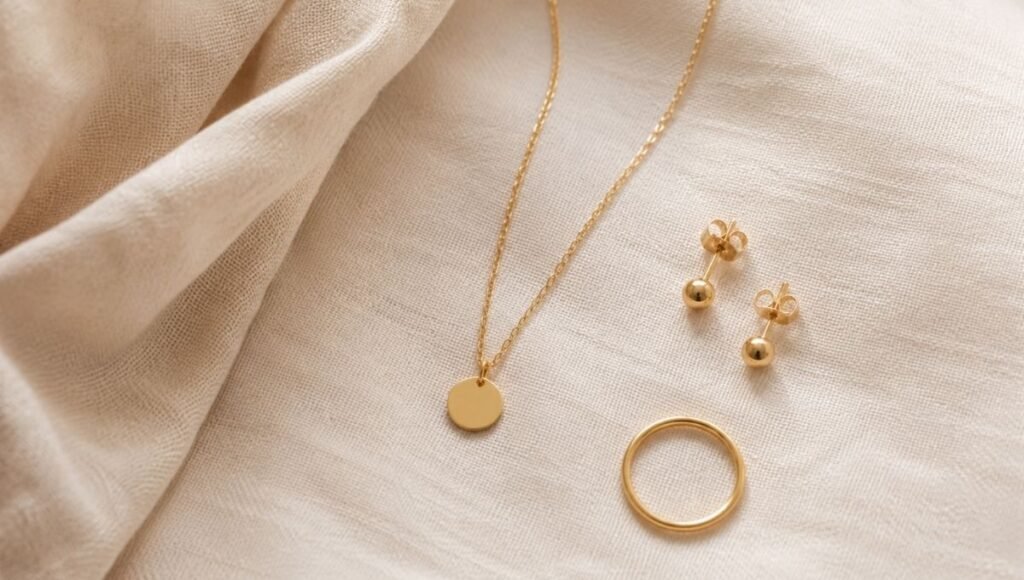
If you take one principle from this guide, make it this one: choose one piece that has a little more personality than everything else, and keep everything around it quiet.
This doesn’t mean bold — it means focal. It might be a slightly thicker chain than your usual delicate one. A ring with a small stone rather than a plain band. A pair of 18mm hoops rather than 12mm. The “more interesting” piece doesn’t need to be dramatic. It just needs to be the piece the eye settles on.
When every piece in a casual look is equally quiet and equally dainty, the whole thing can flatten — it registers as not quite enough. When one piece has just slightly more presence than the others, the look has hierarchy — it reads as considered even though it took almost no effort.
A practical example: Plain white tee, jeans, and: small gold studs + thin chain necklace + plain thin ring. This look is complete but flat. Now swap the chain necklace for one with a small disc pendant. Suddenly the look has a focal point — the pendant is the most interesting thing, the studs and ring are supporting actors — and the whole thing reads as intentional.
Casual Jewelry by Metal Tone
Gold for warm outfit palettes: Beige, camel, rust, cream, olive, brown, white — warm neutrals are naturally amplified by yellow gold. The warmth in the metal echoes the warmth in the outfit and makes the whole look feel cohesive.
Silver for cool and crisp palettes: Bright white, grey, navy, blue tones, black — cool colors are sharpened by silver and white gold in a way that yellow gold can sometimes fight. Silver adds precision rather than warmth.
Either for neutrals: Denim, linen in natural tones, khaki, mid-grey — these are genuinely flexible backgrounds where gold or silver both look right. The choice here is personal preference rather than visual logic.
For mixed-metal casual looks: The modern approach is to wear both, but with repetition. If you’re wearing a gold necklace and a silver ring, add a second piece in each metal so the mix reads as intentional. One gold piece and one silver piece can look accidental; two of each reads as deliberate.
If You Only Have 5 Minutes
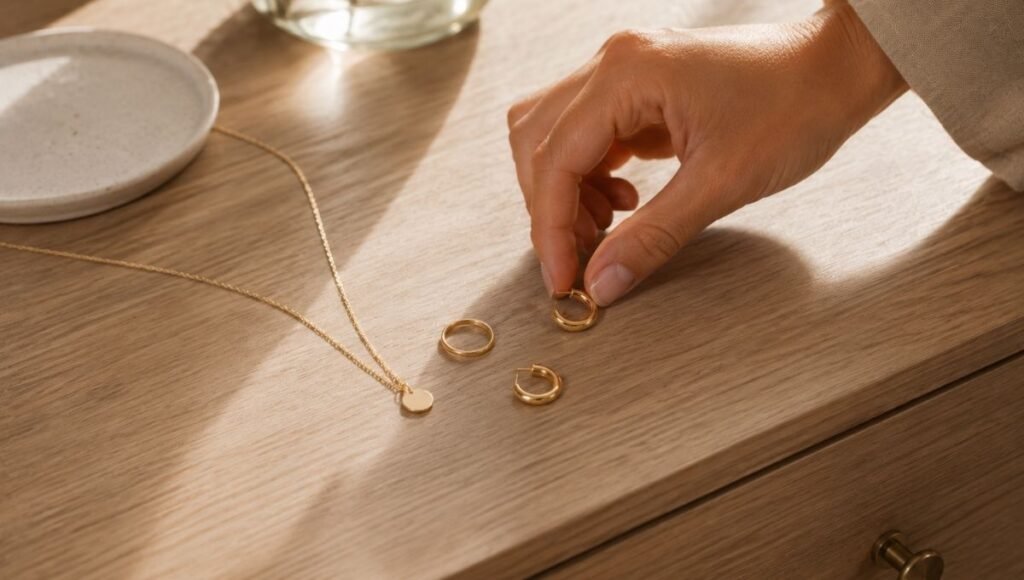
You’re getting dressed and you need to be out the door. Here’s the fastest path to a finished casual look:
Put on the earrings first. Small gold studs or a pair of small hoops in your metal preference. These alone make a casual outfit look more finished than almost any other single piece.
If you have 30 more seconds: add a thin chain necklace at a flattering length. This completes the picture at the collarbone.
If you want one more thing: a simple thin ring on whatever finger feels natural.
Three pieces, under a minute, and the outfit is done. Everything else is optional.
FAQ
What jewelry looks best with casual outfits? Dainty, wearable pieces in your metal preference — a thin chain necklace, small studs or hoops, and a simple ring. The goal with casual outfits is enhancement without drama: jewelry that makes the look feel finished and intentional without overpowering the ease of the clothes.
Should you wear jewelry with casual clothes? Yes — casual clothes almost always benefit from a small amount of the right jewelry. A simple outfit with one or two well-chosen pieces reads as intentionally casual. The same outfit without any jewelry can read as unfinished or low-effort, even if that wasn’t the intention.
What earrings are best for casual outfits? Small hoops (12–18mm diameter) are the most versatile casual earring. They have enough presence to read as jewelry without being formal, they work with hair up or down, and they suit virtually every casual outfit from a tee and jeans to a casual dress. Small studs (under 8mm) are the quieter option — appropriate everywhere, requiring zero thought.
What necklace length works for casual outfits? 16 to 18 inches is the most universally flattering range for casual wear — it sits at or just below the collarbone and works with most casual necklines. For crew necks and higher necklines, 20 to 22 inches lets the necklace sit on top of the fabric rather than disappearing underneath.
Can you wear too much jewelry with casual outfits? Yes — casual clothes have less inherent visual weight than formal pieces, which means they can be overwhelmed by too much jewelry more quickly. One focal piece with two or three quiet supporting pieces is the most reliable formula. When everything is equally bold or equally layered, the casual outfit loses its easy quality and starts to look like an effort.
The goal with jewelry for casual outfits was never to dress the outfit up. It was to make it look like you meant it. Like the jeans and the tee were a choice rather than a default. Like getting dressed this morning took thirty seconds — but good ones.
That’s what a thin chain and the right earrings actually do. Not glamour. Just intention.
Related reading:
- How to Style Jewelry: The Complete Guide for Women → [internal link]
- Minimalist Jewelry: How to Build a Collection That Goes With Everything → [internal link]
- Dainty Jewelry: What It Is, Why It Works, and How to Wear It Every Day → [internal link]
Sources:
- R.C. Wahl Jewelers — How to Style Jewelry for Everyday Looks: Tips for Casual, Work, and Formal Outfits (January 2025)
- Fitaihi Jewelry — Match Jewelry with Outfit: Expert Styling Guide (February 2026)
- Simone Walsh Jewelry — Jewellery Styling Guide: How to Refresh & Wear Your Collection (January 2026)
- Robinson’s Jewelers — How to Style Fine Jewelry with Everyday Outfits (June 2025)