
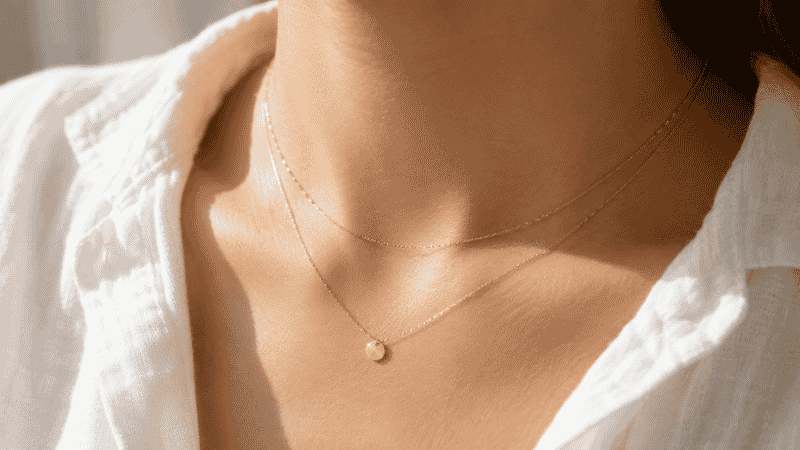
There’s a particular kind of jewelry that doesn’t announce itself. A thin chain that catches the light when you move a certain way. Small earrings you forget you’re wearing until someone leans in close and says, “I love those.” A ring so fine it looks like it was always there, like it grew out of you rather than being placed on you.
This is dainty jewelry — and its appeal isn’t about being understated for its own sake. It’s about a specific quality that almost nothing else in a wardrobe can achieve: the ability to make you feel more yourself without drawing attention to the fact that you’re trying. A large statement piece enters the room before you do. Dainty jewelry goes where you go, quietly, and makes everything feel slightly more finished without anyone being able to say exactly why.
If you’re drawn to this aesthetic but not quite sure what “dainty” means in practice — or how to build a collection that actually works instead of disappearing — this guide covers all of it.
Key Takeaways
- Dainty jewelry is defined by delicacy of scale and refinement of detail — not by price, material, or minimalism specifically
- The most wearable dainty pieces share one quality: they work in multiple contexts without requiring you to think about them
- Gold vermeil, gold filled, and solid 14k gold are the most practical materials for dainty pieces worn daily — the fine scale means any wear shows more quickly, so material quality matters more than in larger pieces
- Dainty jewelry layers beautifully but requires more care in combining than bolder pieces — two thin chains that are too similar in length will tangle and blur together
- As a gift, dainty jewelry is among the most universally received categories — small scale reduces the risk of missing someone’s style
What Does “Dainty” Actually Mean in Jewelry?
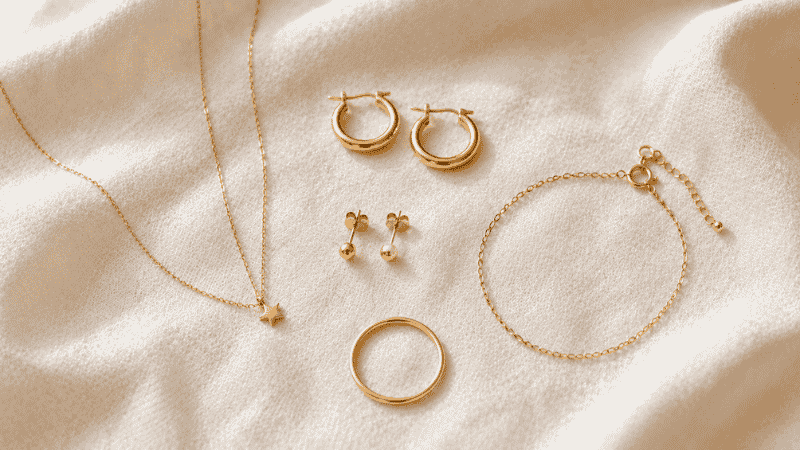
The word gets used loosely — on product pages, in brand names, in style guides — to mean everything from “small” to “delicate” to “minimalist” to “feminine.” In practice, dainty jewelry has a more specific character that’s worth understanding.
Dainty is primarily about scale and proportion. A dainty piece is smaller relative to the body part it adorns than most jewelry. A dainty necklace pendant might be 6 to 10mm — something you’d need to be close to see in detail. A dainty ring is thin-banded, with any stone kept small and close to the band. Dainty earrings sit close to the ear, small in diameter or drop length.
But dainty isn’t the same as minimal. A minimalist piece can be dainty — a plain thin chain, a small plain stud — but dainty pieces can also have detail: a tiny floral motif, a small stone, a fine chain with a tiny charm. What makes them dainty is that the detail is scaled down to something intimate rather than visible-from-across-the-room.
And dainty isn’t the same as fragile. Some of the most durable everyday jewelry is dainty in scale — solid gold chains in fine gauges, tiny stud earrings in hypoallergenic metals, slim bangles that take the same daily wear as heavier pieces. Delicate-looking doesn’t mean delicate-performing, as long as the material is right.
Why Dainty Jewelry Has Become the Dominant Everyday Aesthetic
Ten years ago, the dominant jewelry trend was statement-making. Chunky chains, oversized cocktail rings, layered maximalism. Beautiful in its moment, but demanding — you had to dress around it rather than with it.
The shift toward dainty happened gradually and then all at once. Mie Ejdrup, co-founder of fine jewelry platform Finematter, described what she called “a quieter style of jewelry” emerging — “an intimate, discreet aesthetic that’s for every day, and longer-lasting.” Writing for the Financial Times, she noted that women were looking for pieces they could wear “almost like a second skin — a uniform that they never take off.”
That phrase captures something real. A piece you never take off isn’t a statement. It’s a presence. And the jewelry that achieves that quality is almost always dainty — light enough to forget you’re wearing it, fine enough to feel right in any context, scaled down enough that it doesn’t compete with whatever else is happening in your day.
The result is a category of jewelry that works from a yoga class to a dinner reservation without adjustment. That feels as right with jeans and a t-shirt as with a silk dress. That, as the MEXC jewelry editors put it, “invites closer inspection and serves as a quiet expression of your personality. It’s the difference between a declaration and a secret.”
The Essential Dainty Jewelry Pieces
Not all dainty pieces are equal in terms of how much work they can do in an outfit. These are the pieces that offer the most versatility for their scale.
Dainty Necklaces: The Foundation of Any Layered Look
A fine chain necklace — 14 to 18 inches, 1 to 1.5mm in width — is the most foundational dainty piece. Worn alone, it’s almost architectural in its simplicity: just light and metal. As part of a layered look, it provides the base layer that everything else builds around.
A pendant necklace at the dainty scale means a charm between 6 and 12mm — small enough to sit against the collarbone without creating a focal point, large enough to catch the light and invite curiosity. Initial pendants, tiny geometric shapes, small stones in simple settings, delicate symbolic forms — all of these work at dainty scale.
What to look for: Chain weight matters as much as pendant size. A chain that’s too fine (under 0.8mm) will be hard to clasp and prone to kinking. A chain in the 1 to 1.5mm range is fine-looking but functional.
Dainty Earrings: The Highest-Impact Low-Profile Piece
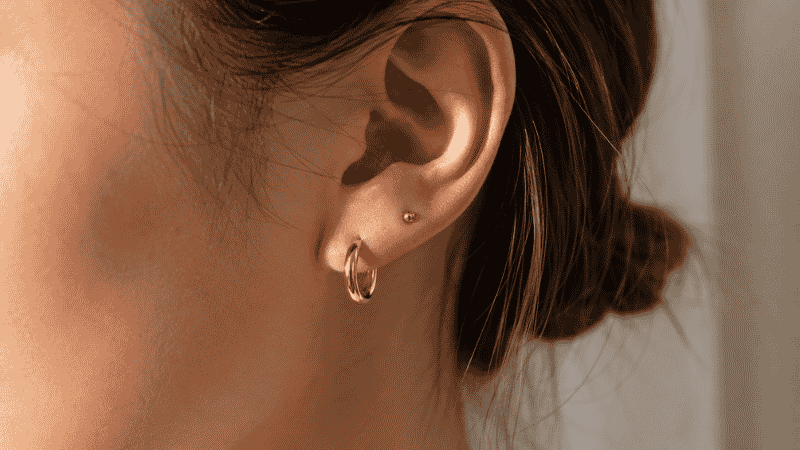
Small hoops between 10 and 16mm — close to the ear, not swinging — are the most versatile dainty earring. They read as jewelry without being ornate. They work with hair up or down, with casual and formal outfits, on their own or as part of an ear stack.
Tiny studs — under 6mm, whether a simple ball, a small disc, a tiny stone — are the most invisible-yet-present earring option. They’re the pair you put in on a morning when you don’t want to think about jewelry and still want to look finished.
Ear cuffs and small huggies at the dainty scale add dimension to an ear stack without requiring additional piercings or heavy weight.
Dainty Rings: The Most Personal Category
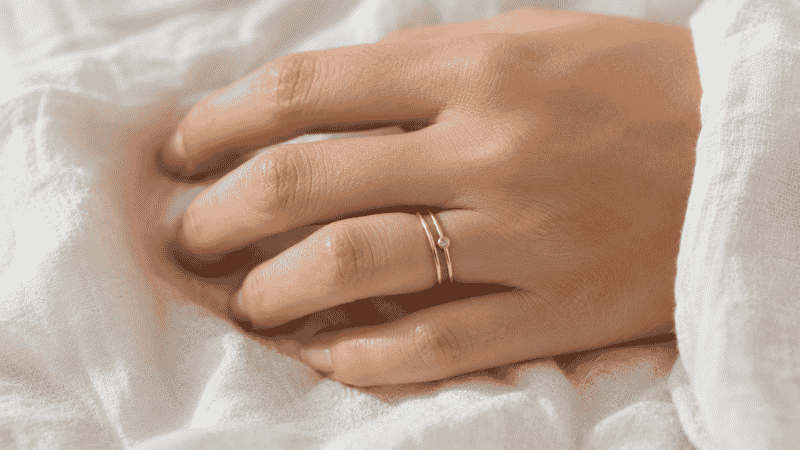
A thin band ring — 1 to 2mm width, whatever metal suits you — is the simplest dainty ring investment. It does almost nothing and somehow changes everything about how your hand looks. It can be worn alone on any finger as a quiet punctuation mark, or stacked with other thin bands for a more collected look.
Small stone rings at dainty scale keep the stone close to the band — bezel-set or flush-set rather than elevated. A tiny diamond, a small sapphire, a birthstone chip — all beautiful at this scale, all wearable in contexts where a larger stone ring would feel excessive.
Dainty Bracelets: Quiet on the Wrist
A chain bracelet in the 1 to 2mm width range is the wrist equivalent of a dainty necklace — present without demanding. A slim bangle in solid metal has slightly more visual weight but still reads as refined rather than bold. Both work alone as a single-wrist statement of restraint, or as the starting layer of a wrist stack that builds outward.
How to Style Dainty Jewelry Without It Disappearing
The most common frustration with dainty jewelry is that it doesn’t photograph well, doesn’t read across a room, and sometimes feels like it barely makes an impression. This is often a styling problem rather than a piece problem.
Layer deliberately. A single fine chain at 16 inches is beautiful in person and nearly invisible in photos. Two or three chains at 16, 18, and 20 inches — each slightly different in style — create a layered effect that reads clearly and photographs as a cohesive look. The individual pieces are still dainty; the combination has presence.
Match the scale to your frame. Dainty jewelry looks most intentional when it’s proportionate. On a finer frame with smaller features, a 6mm pendant sits perfectly at the collarbone. On a larger frame, the same pendant might need to be 10mm to have visual weight. Neither is wrong — scale to what looks purposeful on your body specifically.
Let one piece have slightly more presence. In a dainty look, variety in weight creates hierarchy. If everything is equally fine and equally minimal, the whole look can flatten. One piece slightly more substantial — a small stone ring, a 16mm hoop instead of 12mm, a pendant with a bit more presence — anchors the rest.
Context is everything. Dainty jewelry reads differently against different backgrounds. Against a bare neckline, a fine chain is visible and beautiful. Against a crewneck knit, it disappears. With open necklines, lower collars, and skin-baring styles, dainty jewelry finds its most natural home.
Dainty Jewelry and Material: Why Scale Makes Quality Matter More
Here’s a specific truth about dainty jewelry that doesn’t apply as strongly to larger pieces: at small scale, wear shows faster.
A large statement ring and a thin dainty ring both start with the same gold plating. But the dainty ring contacts more surface area relative to its size, flexes more with wear, and has less material buffering the plating from friction. The same plating thickness lasts six months on a chunky ring and four months on a dainty one.
This is why material quality matters more in dainty jewelry than in bolder pieces. The investment in gold vermeil, gold filled, or solid gold is more defensible for a thin everyday chain you wear constantly than for a statement piece you wear occasionally.
For dainty pieces worn daily: Gold filled is the most practical non-solid option — thick gold layer, bonded construction, genuine longevity. Gold vermeil is the most refined feel — sterling silver base, appropriate quality for pieces that sit close to skin. Solid 14k gold is worth considering for the one or two pieces you genuinely never take off.
For dainty pieces worn occasionally: Gold vermeil or quality gold plating over sterling silver are entirely reasonable. The lower wear frequency means the shorter lifespan of plating matters much less.
Dainty Jewelry as a Gift
Dainty jewelry is one of the safest gift categories precisely because of what it is — small in scale, personal in effect, non-imposing in style.
A large, dramatic piece as a gift is a risk. It reflects the giver’s taste as much as the recipient’s, and if it doesn’t suit their style, it’s beautiful but unwearable. A dainty piece in the recipient’s metal preference (observable from what they already wear) almost always lands — because it’s small enough to layer with what they have, unspecific enough not to require a particular aesthetic, and refined enough to feel considered.
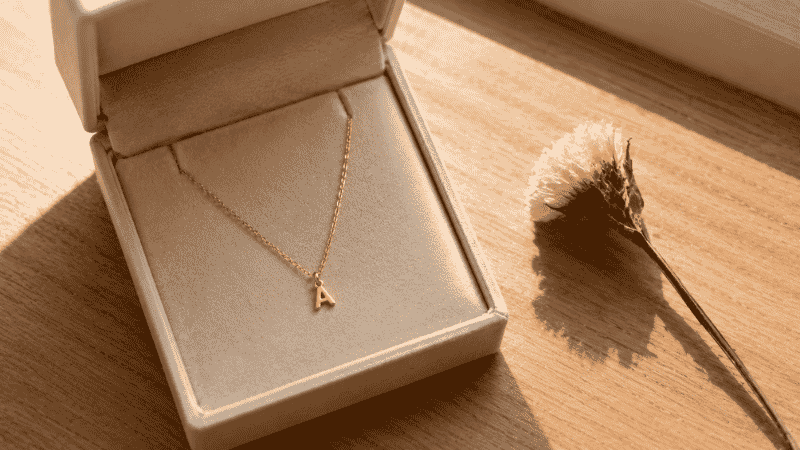
For a birthday: a delicate initial necklace, tiny birthstone studs, a thin chain bracelet. Things that add to what she already wears rather than replacing it.
For a best friend: matching dainty pieces — two thin chain necklaces with complementary pendants, two small hoops — that can be worn together or separately.
For a colleague or someone you don’t know as well: a simple pair of small hoops or tiny studs in gold or silver. The most universally appropriate dainty jewelry gift.
FAQ
What is dainty jewelry? Dainty jewelry is defined by small scale and refined detail — pieces that are delicate in proportion to the body, designed to be wearable in any context, and more quietly beautiful than dramatically visible. It includes fine chain necklaces, small stud earrings, tiny hoops, thin band rings, and slim bracelets.
Is dainty jewelry the same as minimalist jewelry? They overlap but aren’t the same. Minimalist jewelry is defined by the absence of decoration — clean forms, nothing extra. Dainty jewelry is defined by small scale — it can have decorative detail (a small floral motif, a tiny stone) as long as that detail is kept intimate in size. A plain thin chain is both. A small floral pendant is dainty but not strictly minimalist.
What metal is best for dainty jewelry? Gold filled or gold vermeil for everyday dainty pieces. Solid 14k gold for pieces worn constantly. The fine scale of dainty jewelry means plating wears faster than on larger pieces — material quality matters more here than in bolder jewelry.
Can dainty jewelry be layered? Yes — and layering is where dainty jewelry finds its most visible expression. Two or three fine chains at slightly different lengths, worn together, have much more presence than any single piece alone. The key is length separation: leave at least one to two inches between each chain to prevent tangling and ensure each piece reads distinctly.
Is dainty jewelry good for sensitive skin? It depends on the material. Dainty pieces in gold vermeil (gold over sterling silver), solid 14k or 18k gold, titanium, or niobium are safe for most sensitivities. Standard gold plating over brass becomes more of a concern with dainty pieces because the thin scale means more skin contact relative to the piece’s size.
Dainty jewelry works because it doesn’t require anything from you. It doesn’t need a statement outfit, a special occasion, or a particular confidence. It just sits there, quietly enhancing — making you feel slightly more like yourself at 7am and still right at midnight.
That’s the thing about jewelry that speaks softly. You hear it most clearly when it’s yours.
Related reading:
- Minimalist Jewelry: How to Build a Collection That Goes With Everything → [internal link]
- How to Layer Necklaces: The Formula That Always Works → [internal link]
- How to Choose Jewelry That Actually Feels Like You → [internal link]
Sources:
- Financial Times / Finematter — Why micro jewellery and dainty chains are the new luxury trend (Mie Ejdrup, co-founder of Finematter)
- MEXC News — The Rise of Minimalist Jewelry: How Subtle Pieces Elevate Everyday Style (January 2026)
- South China Morning Post — Why micro jewellery and dainty chains are the new luxury trend
- Alicia M. Lund / Substack — Elevating the Everyday: About the Dana Rebecca Collaboration