
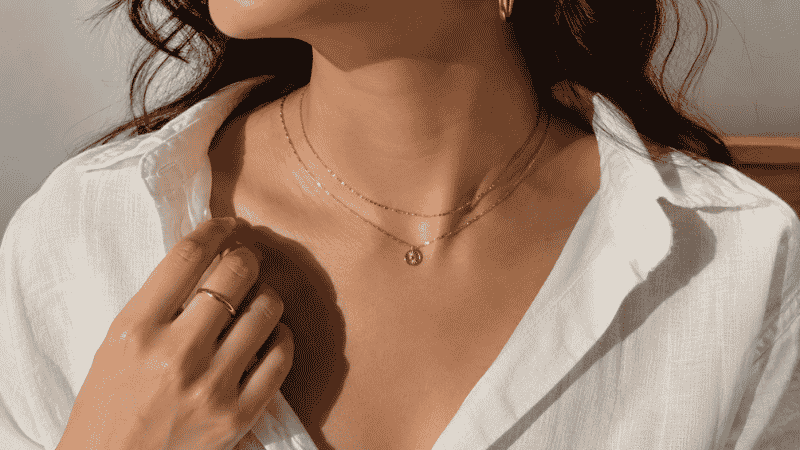
Most people think of jewelry styling as a set of rules. Match your metals. Don’t wear statement earrings with a statement necklace. Keep it simple at work. These rules exist for a reason, but following them without understanding why often produces outfits that feel technically correct and somehow flat — like someone dressed by a checklist rather than by instinct.
The better approach is understanding the principles behind the rules. Once you know why a V-neck calls for a specific necklace length, or why two pieces at the same visual weight compete rather than complement, the decisions become intuitive. You stop asking “what do I wear with this?” and start reaching for pieces that feel right without consciously calculating why.
This guide covers the complete picture of how to style jewelry — from matching pieces to necklines and occasions, to building a layered look, to developing a personal style that makes every outfit feel finished. Each section links to deeper reading on specific topics. Think of this as your map; the individual guides are where you go to go deeper.
Key Takeaways
- Jewelry styling is about harmony, not matching — the goal is for your pieces and outfit to feel like they belong together, not like they were coordinated
- The neckline of what you’re wearing is the most important factor in choosing a necklace — it determines both the length and the scale of piece that will look right
- One focal point per look is the most reliable styling principle — one statement element, with everything else supporting rather than competing
- Proportion matters more than color or metal — a piece that’s the wrong scale for your frame or the outfit will look off regardless of how beautiful it is alone
- Personal style develops through observation and repetition, not rules — notice what you reach for naturally, and build from there
The One Principle That Overrides All the Rules
Before anything else: the goal of jewelry styling is not to follow rules correctly. It’s to create harmony — a state where your pieces and your outfit look like they were meant for each other, where nothing is fighting for attention and nothing is drowning.
Harmony happens when things share a register. A casual linen outfit and delicate dainty jewelry share a register. A formal silk dress and refined gold pieces share a register. A maximalist print and bold statement jewelry share a register. When the register doesn’t match — when you wear understated jewelry with a very bold outfit, or statement pieces with a quiet, refined look — the mismatch is what you notice, even if you can’t articulate why.
This is why rigid rules often fail. “Don’t mix metals” is a rule, but mixing metals intentionally, with a bridge piece that incorporates both, creates a look more interesting than all-gold or all-silver. “Less is more” is a rule, but sometimes more is exactly right. The principle underneath all the rules is the same: create harmony. Everything else is guidance for how to get there.
How to Style Jewelry with Different Necklines
The neckline of your outfit is the frame for your necklace. Getting this relationship right transforms a look from assembled to intentional.
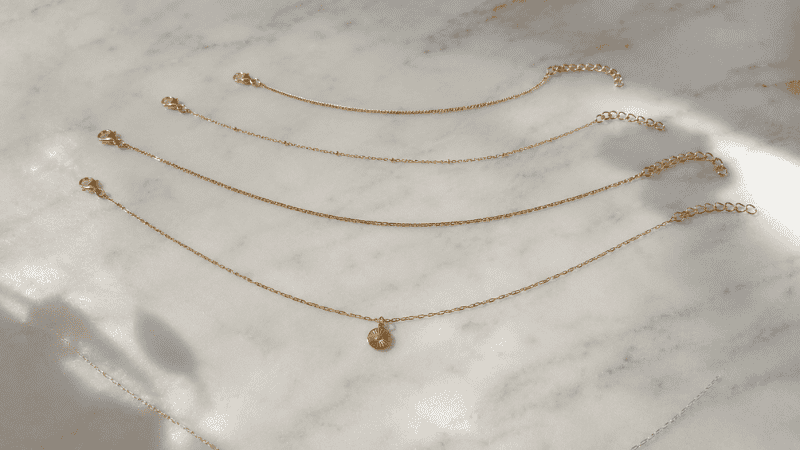
V-Necks and Open Necklines
V-necks create a natural downward arrow that guides the eye. Jewelry that follows this direction — a pendant that echoes the V shape, a longer chain that falls with the opening — feels like it belongs. For V-necks, necklaces at 18 to 22 inches work best. The pendant should sit above the bottom of the V, not below it.
Layered necklaces read beautifully against V-necks because the open neckline gives them canvas. Two or three chains at different lengths, following the V, look effortless rather than cluttered.
Crew Necks and Round Necklines
Pieces shorter than 18 inches will sit under the fabric and disappear. For crew necks, start at 20 inches — the necklace should sit on top of the fabric, creating a deliberate contrast with the closed neckline. Longer necklaces at 22 to 24 inches work even better, letting the pendant fall against the fabric and become part of the composition rather than fighting the collar.
High Necks and Turtlenecks
High necklines cover the collarbone entirely, which means necklaces need to be long enough to drape over the fabric — 22 inches or longer. This is actually an underused canvas for statement necklaces, because the covered neckline gives bolder pieces somewhere to land without competing with an exposed collarbone.
Statement earrings are often the better choice with high necklines. When the neck is covered, the ear becomes the natural jewelry focus.
Strapless and Off-Shoulder
Exposed shoulders and bare collarbone give jewelry maximum visibility and minimum competition. Both extremes work beautifully: a choker or collar necklace at 14 to 16 inches that sits high on the neck, or a long pendant at 24 inches that falls dramatically against the bare skin.
Statement earrings pair well with strapless because the bare shoulder creates space for longer drops without the interference of fabric.
Boat Necks and Square Necklines
Wide, horizontal necklines naturally frame the collarbone and shoulders. Pieces that honor this horizontal quality — a longer pendant, pieces that draw the eye along the line rather than down from it — work best. A choker or collar necklace at 14 to 16 inches sits beautifully against a boat neck, following its line.
→ For the complete necklace and neckline guide: [Jewelry for Every Neckline: The Complete Matching Guide]
How to Style Jewelry by Occasion
The register of your jewelry should match the register of the occasion. Not identical — but harmonious.
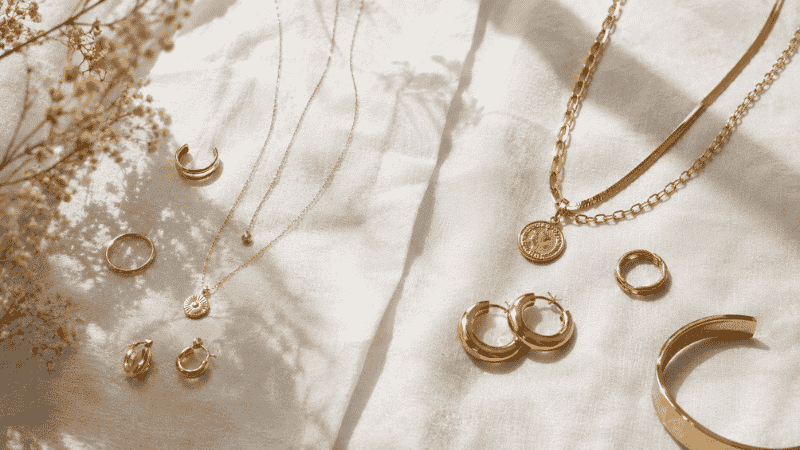
Everyday and Casual
Casual styling is where dainty, minimalist jewelry does its best work. Fine chains, small studs, thin rings, slim bracelets — pieces that feel effortless rather than constructed. The goal is jewelry that enhances without announcing: you notice it’s there, but it doesn’t demand attention.
Two to three pieces maximum for most casual occasions. Let each piece have breathing room.
→ For everyday jewelry guidance: [Minimalist Jewelry: How to Build a Collection That Goes With Everything] → For the dainty aesthetic specifically: [Dainty Jewelry: What It Is, Why It Works, and How to Wear It Every Day]
Professional and Office
Office jewelry needs to be refined, not absent. The distinction is scale and drama: small hoops rather than long drops, a single delicate necklace rather than a layered stack, rings worn with restraint. Classic pieces in quality materials — gold vermeil, gold filled, sterling silver — look appropriate in almost any professional context.
The rule of thumb: if you’d have to remove a piece before a meeting because it’s distracting, it’s too much for the office. If you could wear it in a boardroom without anyone noticing it specifically, it’s right.
Evening and Special Occasions
Evening is when you have permission to add weight, drama, and scale that would feel excessive during the day. A statement necklace that you love but never wear to work. A pair of chandelier earrings. A bold cuff. The occasion creates the context that makes these pieces feel appropriate rather than overdone.
The styling principle for evening: choose one dramatic focal point and let everything else support it. A statement necklace with simple studs. Bold earrings with a plain chain. A dramatic cuff with no other bracelets. One element at a time.
How to Style Jewelry for Your Face Shape
Face shape matters most for earrings — the shape and drop length of an earring can elongate, widen, soften, or define your features depending on how it relates to your bone structure.
Round faces are flattered by elongating shapes — long drops, narrow dangles, angular designs that create vertical movement. Avoid very round, wide hoops that echo and emphasize the roundness.
Oval faces are the most balanced proportions — most earring styles work, which gives you the most freedom to experiment with scale and drama.
Square or angular faces are softened by curved, rounded shapes — hoops, teardrop forms, anything with gentle curves rather than sharp angles.
Heart-shaped faces (wider forehead, narrower chin) are balanced by earrings that widen at the jaw level — chandelier styles, wider drops that create width lower on the face.
Long or oblong faces benefit from wider, shorter earrings that create horizontal movement — button earrings, wide hoops, studs with some surface area.
→ For the complete face shape and jewelry guide: [How to Match Jewelry to Your Face Shape and Skin Tone]
How to Style Layered Necklaces
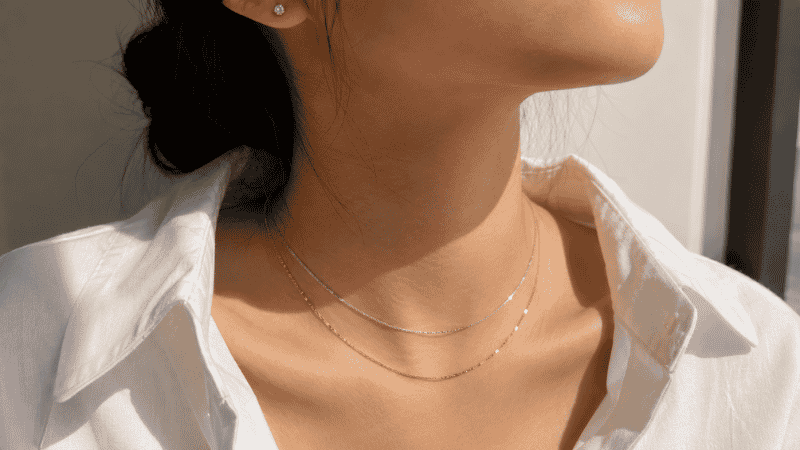
Layering necklaces is one of the most versatile and most frequently mishandled jewelry techniques. Done well, it looks like something you just happened to put on. Done poorly, it looks tangled and chaotic.
The key is length separation: pieces need at least one to two inches of vertical space between them to sit independently rather than tangling. A 16-inch choker, an 18-inch collarbone chain, and a 20-inch pendant creates a clean three-layer stack. A 17-inch and 18-inch chain are too close and will spend the day knotted together.
Texture contrast prevents pieces from blurring together — a smooth plain chain next to a slightly different chain style, a pendant next to a chain-only piece. When every layer is identical in character, the look flattens.
Put the thinnest chain on first, heavier pieces over the top. This keeps delicate chains from getting trapped under heavier ones and creating uncomfortable pressure.
→ For the complete layering guide: [How to Layer Necklaces: The Effortless Formula]
How to Style Layered Bracelets
A wrist stack follows the same logic as a necklace layer, but the focal point works differently. Every successful bracelet stack starts with one anchor piece — the piece with the clearest identity — and builds outward from there.
Contrast in texture and width is what makes a stack look curated rather than random. A smooth polished bangle next to a chain bracelet next to a slightly textured piece creates visual rhythm. Three identical bangles create a set, not a stack.
The stack should cover no more than one-third of your forearm — beyond that it stops reading as jewelry and starts reading as a costume.
How to Mix Metals Without It Looking Accidental

The old rule against mixing gold and silver has largely dissolved. Mixed-metal styling looks contemporary and intentional when it’s done with a specific technique: repetition.
If you have one gold piece and one silver piece, the mix can look accidental. If you have two gold pieces and one silver piece — or vice versa — the repeated metal creates a dominant tone and the contrast reads as deliberate. The majority metal is the theme; the minority metal is the accent.
A bridge piece that incorporates both metals — a two-tone chain, a pendant with mixed-metal elements — makes any mixed stack feel more cohesive by visually connecting the two tones.
How to Balance Statement and Subtle Pieces
The most reliable styling principle: one focal point per look.
A statement necklace is the focal point — it should be paired with simple studs or no earrings, and minimal other jewelry. Statement earrings are the focal point — pair with a plain chain or nothing at the neck, simple rings and bracelets. A bold ring stack is the focal point — let the neck and ears be quiet.
When multiple statement elements compete, the look becomes busy. When one statement element is supported by quiet pieces, it reads with the clarity it deserves.
This doesn’t mean everything else has to disappear — it means everything else steps back. Small studs with a statement necklace. A plain chain with bold earrings. A single slim bangle with an otherwise stacked ring look. The quiet pieces are doing real work; they’re just doing it without announcing themselves.
How to Develop Your Personal Jewelry Style
Rules can tell you what works technically, but they can’t tell you what feels like you. Personal jewelry style develops through observation — noticing what you reach for, what you avoid, and what makes you feel most like yourself when you see yourself in the mirror.
A few questions that accelerate this process:
What pieces do you wear constantly without thinking about it? Those pieces are telling you what your real preferences are, not your aspirational ones.
What metal tone do you reach for? Most people have a strong preference, even if they think they’re flexible. Look at what you’re actually wearing.
What scale feels natural? Some people feel most themselves in dainty pieces; others feel dressed down or incomplete without something with real presence. Neither is wrong — scale preference is personal.
What occasions do you feel least certain about? Those are the contexts where a few reliable go-to combinations (a specific pairing you know works) will save you more time and frustration than any rule.
Common Jewelry Styling Mistakes — and How to Avoid Them
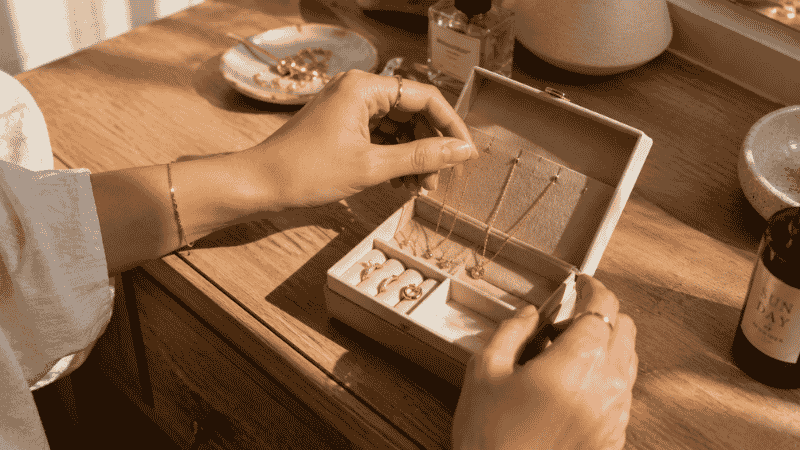
The mistakes that most often derail an otherwise good look:
Wearing pieces that compete at the same visual weight — two statement elements fighting for the same space.
Ignoring the neckline — putting on whatever necklace you like regardless of whether it suits what you’re wearing.
Wearing everything at once — the impulse to wear everything you love in one outfit almost always results in too much. Edit down.
Ignoring proportion — a piece that’s too small for your frame disappears; one that’s too large overwhelms. Scale to what actually looks right on your body.
Wearing something uncomfortable — jewelry you’re constantly adjusting, that slips, that catches, that you’re aware of all day, will never look as good as something you’ve forgotten you’re wearing.
→ For a deeper look at styling mistakes: [7 Accessory Mistakes That Are Ruining Your Outfits (And How to Fix Them)]
FAQ
What jewelry should I wear every day? A small pair of studs, a delicate chain necklace at a flattering length, and one simple ring — all in your metal preference — is a complete, versatile everyday look that works in almost any context. Build from these three pieces outward as your collection grows.
How do I know what jewelry goes with my outfit? Start with the neckline: it determines your necklace length and scale. Then match the register: casual outfit calls for understated pieces, formal occasion allows for more drama. Finally, choose one focal point and let everything else support it.
Can I wear gold and silver jewelry together? Yes — repeat each metal at least twice in your look for the mix to read as intentional rather than accidental. A bridge piece that incorporates both metals helps create visual cohesion.
How much jewelry is too much? When you can’t identify a clear focal point — when everything is competing for attention — that’s too much. The practical test: if you’d feel self-conscious about being overdressed for your actual plans, edit one piece out.
How do I build a personal jewelry style? Observe what you already reach for naturally — the pieces you wear without thinking. Those are your actual preferences. Build your collection around more of what you already love rather than aspirational pieces that don’t suit how you actually dress.
Jewelry styling isn’t a set of rules to memorize — it’s a set of principles to internalize until the decisions feel natural. The goal is to reach a point where you put on what feels right without consciously calculating why, and the result is consistently an outfit that looks finished and intentional.
That point comes from trying things, noticing what works, and building the confidence to trust your own instincts. The guides below are where to start.
Complete Style Guides Collection
Every section of this guide links to a deeper article. If a topic here sparked a question, the full answer is in one of these:
- [How to Layer Necklaces: The Effortless Formula] → length separation, texture contrast, tangle prevention
- [How to Layer Bracelets: The Simple Formula] → anchor pieces, proportion, wrist stack building
- [Minimalist Jewelry: How to Build a Collection] → the minimalist aesthetic, five foundational pieces
- [Dainty Jewelry: What It Is, Why It Works] → dainty defined, styling, material considerations
- [How to Choose Jewelry That Actually Feels Like You] → skin tone, face shape, lifestyle, gifting
- [7 Accessory Mistakes Ruining Your Outfits] → the most common errors and how to fix them
Sources:
- Fitaihi Jewelry — Match Jewelry with Outfit: Expert Styling Guide (February 2026)
- Nuyug Jewelry — How to Match Jewellery with Necklines: A Complete Style Guide (October 2025)
- Bondeye Jewelry — The Essential Guide to Wearing Jewelry: Rules for Effortless Style (November 2024)
- Q Evon Fine Jewelry — Necklace Styling 101: Wearing Necklaces for Different Necklines (October 2025)