
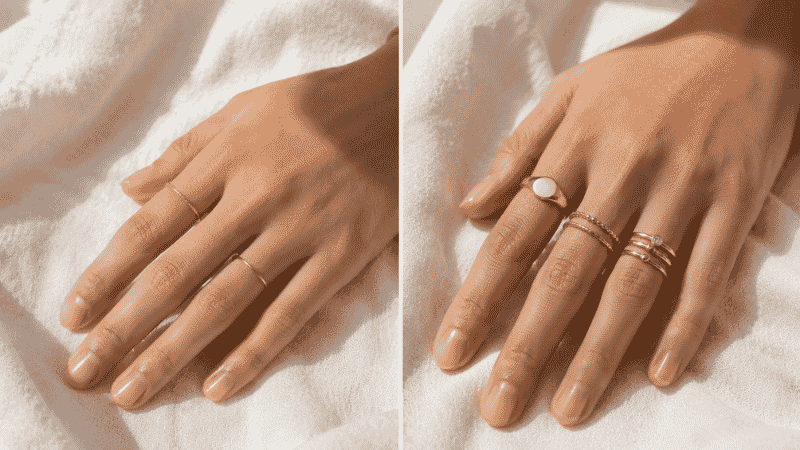
Rings are the most personal piece of jewelry you can wear. A necklace sits against your collarbone and catches light when you move. Earrings frame your face. But rings are on your hands — constantly visible, constantly in motion, part of how you gesture and reach and exist in the world. They’re the pieces people notice up close.
Which is exactly why they can feel the most confusing to style. On the right hand, in the right combination, rings look effortless. On the wrong finger, or in the wrong number, they can look either too much or strangely incomplete. And unlike necklaces or earrings, where most people have a basic mental model for what works, rings feel like they have their own logic — one that isn’t always obvious until you understand the underlying principles.
This guide covers all of it. Which finger to wear a ring on and what each finger communicates. How many rings is too many. How to build a ring stack that looks curated rather than random. How to wear rings for different occasions. And how to find the ring combination that feels genuinely like you rather than borrowed from someone else’s aesthetic.
Key Takeaways
- There are no rules about which finger you must wear a ring on — but each finger has its own proportional character and communicates differently, which is useful to know
- The most wearable everyday ring is a thin plain band — it goes with everything, suits any finger, and forms the foundation of any stack
- Ring stacking works best when pieces vary in width and texture rather than being identical — contrast creates visual interest; sameness creates blur
- The one-third rule: rings should cover no more than one-third of your finger length to maintain proportion and comfort
- Rings are “the most personal form of jewelry” — how you wear them says something specific about you, which is what makes getting it right feel so satisfying
Which Finger to Wear a Ring On: What Each Finger Communicates
Understanding the character of each finger helps you make more intentional choices. None of this is rigid — these are tendencies and cultural associations, not requirements.
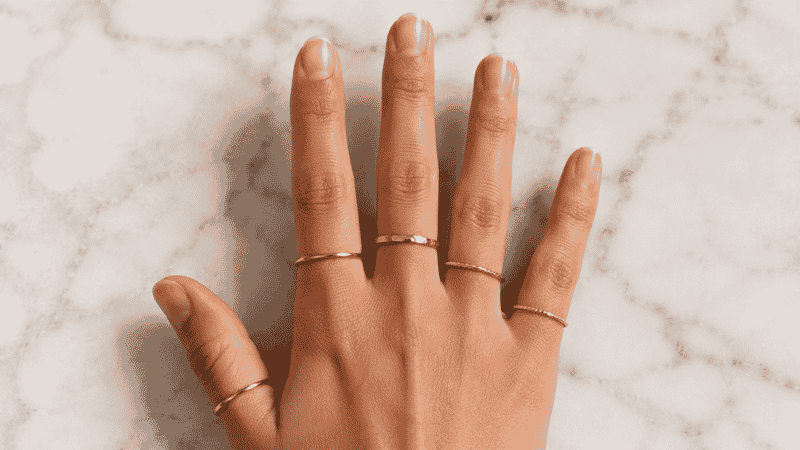
The Ring Finger (Fourth Finger)
The most culturally loaded finger in Western jewelry tradition. The ring finger on the left hand is associated with romantic commitment — engagement rings, wedding bands, promise rings. On the right hand, the same finger is much more neutral, commonly used for fashion rings, birthstone rings, and any ring with personal significance that isn’t romantic.
If you want to wear a ring that has meaning — a ring from a family member, something that marks a personal milestone — the ring finger on the right hand is a natural home for it.
The Index Finger (Pointer Finger)
The index finger is one of the most underused fingers for rings, which makes it one of the most interesting choices. A ring on the index finger is immediately visible — you point, you gesture, you reach, and whatever’s on that finger goes with you. It reads as deliberate and confident.
Bold pieces — a signet ring, a larger stone, something with clear visual presence — work particularly well on the index finger because the finger’s natural prominence gives the ring room to be seen. Thin, delicate rings can look proportionally small on the index finger depending on your hand size.
The Middle Finger
The middle finger is the longest and most central finger on the hand, which makes it the natural home for a focal piece — whatever ring you want to be the center of visual attention. A statement ring on the middle finger anchors a look in a way that’s hard to achieve elsewhere.
Because the middle finger sits between the index and ring fingers, a ring here doesn’t read as romantically coded or as particularly bold in placement. It’s the most neutral finger for a statement piece — the ring does the work, not the finger choice.
The Pinky Finger
The pinky ring has a long history — in various cultures it’s been associated with family heritage, profession, and personal independence. Today it’s simply one of the most interesting styling choices: a ring on the pinky reads as considered and slightly unconventional.
Because the pinky is small, it suits smaller, more refined pieces — a thin plain band, a small signet, a dainty ring with a tiny stone. Large, heavy rings look disproportionate on a pinky finger regardless of how beautiful they are otherwise.
The Thumb
Thumb rings are the boldest ring placement — there’s no cultural coding around them, so the choice reads as purely aesthetic. A ring on the thumb has genuine presence because the thumb is the widest and most independently mobile finger; whatever’s there gets seen.
Wider bands and cuffs work better on thumbs than thin, delicate rings, which can look lost. If you’re drawn to a more expressive, maximalist ring look, the thumb is one of the most interesting places to start.
How Many Rings Is Too Many?
This is the question most people actually need answered, and the honest answer is: it depends on the proportion, not the number.
A single bold ring on the right finger can make more impact than five rings worn without thought. Six rings worn with clear intention — varying widths, a defined focal point, deliberate spacing — can look extraordinary. The question isn’t the count; it’s whether the look has structure or whether it just looks like everything landed on your hands at once.
A practical guide by occasion:
Everyday and work: One to three rings per hand is the most universally appropriate range. Enough to look considered, not so many that the hands themselves become a statement when the context doesn’t call for it.
Casual and weekend: Three to five rings across both hands. Room for more personality and layering, more freedom to experiment with bolder combinations.
Evening and special occasions: As many as the look calls for — this is where ring stacking finds its most dramatic expression. The occasion creates the context that makes more rings feel appropriate rather than excessive.
One principle that applies across all occasions: leave at least one finger bare per hand. Empty space creates visual breathing room and lets the rings you are wearing read more clearly. A hand where every finger has a ring tends to look cluttered even when each individual ring is beautiful.
How to Build a Ring Stack That Looks Intentional
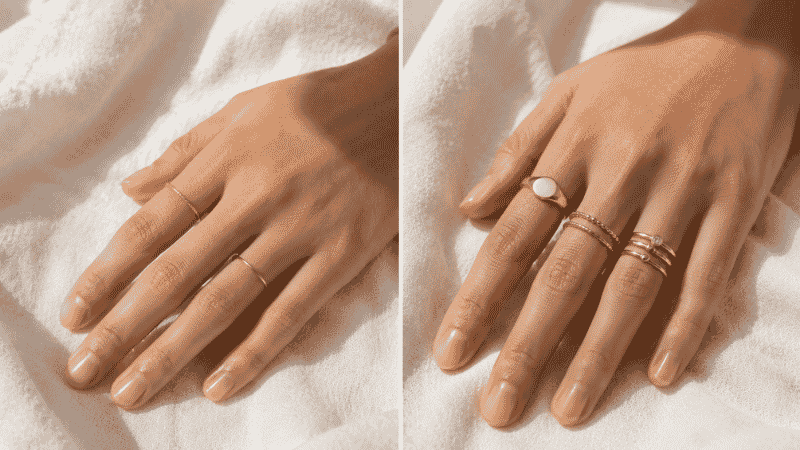
Ring stacking — wearing multiple rings on one finger — has its own logic, and it’s similar to necklace layering: contrast creates interest, sameness creates blur.
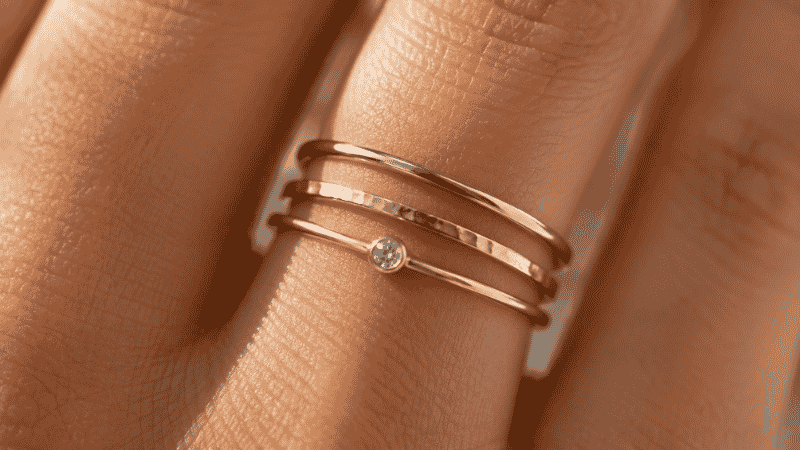
Start with one anchor piece. The anchor ring is the most visually distinctive piece in the stack — the one with the clearest identity. It might be a ring with a small stone, a slightly wider band, or simply a piece with more presence. Everything else in the stack responds to it.
Add contrast in width. A thin plain band next to the anchor creates separation. A medium-width band on the other side gives balance. Three identical-width bands on one finger blend into one visual block — you can’t read them as separate pieces.
Vary texture. A smooth polished band next to a slightly hammered or textured ring, or next to a band with a small setting, creates dimension. When every ring has the same surface quality, the stack flattens.
Keep it comfortable. This sounds obvious but is genuinely easy to overlook: rings that are too tight against each other on one finger become uncomfortable by midday and restrict movement. Leave a small visible gap between each ring. The gap also makes each piece more readable as a distinct element.
The practical limit: On most fingers, two to three rings is the functional limit for daily wear without the stack feeling restrictive. On the index or middle finger, where there’s more length, three or four is possible. On the pinky or ring finger, two tends to be the comfortable maximum.
How to Wear Rings on Multiple Fingers
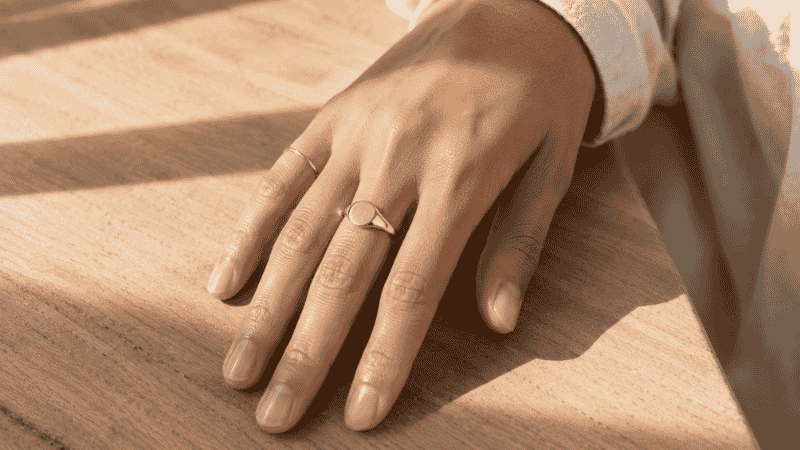
Wearing rings on more than one finger — sometimes called “multi-finger styling” — follows the same principle as any jewelry combination: one focal point, everything else in support.
Choose your dominant hand for the main statement. Whether your focal piece is a single bold ring or a more elaborate stack, it usually reads better anchored on one hand rather than split between both. Your non-dominant hand can have simpler, quieter pieces.
Balance across fingers, not just across hands. If you have a ring on your index finger and your ring finger, the visual weight should feel distributed — not all concentrated at one end of the hand. A simple thin band on the middle finger between two more substantial pieces creates a visual bridge.
Use negative space. Leaving some fingers bare — even on the dominant hand — gives the rings you’re wearing more room to be appreciated. The empty fingers make the worn ones look more intentional.
Match the register. Dainty rings across multiple fingers look cohesive and delicate. Bold rings across multiple fingers look maximalist and expressive. Mixing dainty rings on some fingers and a statement ring on another creates hierarchy — which works well if the statement ring has enough presence to hold its position as the focal point.
How to Wear Rings for Different Occasions
Everyday and work: One or two thin rings — a plain band, a simple stacking ring, a ring with a small stone. Nothing that extends much above the finger profile or that catches on fabric during normal work activities. The goal is rings you forget you’re wearing.
Casual: Two to four rings, more room for personal expression. A stack on one finger, a single ring on another, some combination that feels like your actual style rather than a considered presentation.
Formal and evening: This is where a statement ring earns its place. A cocktail ring, a ring with more presence, a stack with some drama. When you’re wearing a formal outfit, the jewelry needs to match the occasion’s visual weight — a single thin band can look unfinished next to a silk dress.
Active and travel: One ring maximum, and ideally one in a durable material — gold-filled or solid gold rather than plated. Rings experience more friction and contact than any other jewelry; this is where material quality shows up most quickly in wear.
A Note on Ring Sizing and Fit
A ring that fits properly is one where you can slide it on and off without force, and it sits comfortably on the finger without sliding or spinning. It should move when you intentionally move it but stay in position through normal hand movement.
Fingers swell in heat and shrink in cold, which means a ring that fits perfectly in winter might feel tight in summer and vice versa. If you’re buying a ring for a finger that tends to swell, buy at the larger size — a ring that’s slightly loose is always more comfortable than one that’s too tight.
For stacking: when wearing multiple rings on one finger, size the inner rings slightly larger than you would wear alone. The stacked rings create pressure that makes each individual ring feel tighter than it would on its own.
FAQ
Which finger should I wear a ring on? Any finger works — but each finger has its own character. The ring finger reads as romantic or meaningful. The index finger reads as deliberate and confident. The middle finger anchors a statement piece naturally. The pinky reads as considered and slightly unconventional. The thumb is the boldest choice. Wear where it feels right for the ring and the message you want it to carry.
How many rings should I wear at once? One to three rings per hand is the most versatile range for everyday wear. Beyond that, the look becomes more of a statement — which is fine when the occasion calls for it. The more important question is whether the combination looks intentional, not how many rings are on your hands.
Can I wear rings on every finger? Technically yes, but leaving at least one finger bare per hand creates visual breathing room and makes the rings you are wearing easier to read. A hand where every finger is covered tends to look busier than one where a few fingers are deliberately left empty.
How do I stop rings from spinning on my finger? A ring that spins is slightly too large. Options: have it resized by a jeweler (usually inexpensive), use a ring adjuster insert (a small plastic or metal band that fits inside the ring to take up space), or wear it on a warmer day when fingers are slightly more swollen.
Is it okay to wear rings on both hands? Yes — and it can look very considered when done intentionally. Keep the dominant hand as the main statement and the non-dominant hand simpler. Or repeat a consistent element — same metal, same thin band style — across both hands to create cohesion without symmetry.
Rings are the most personal piece of jewelry precisely because they’re so visible, so constantly present, and so tied to meaning — whether that meaning is romantic, sentimental, or purely aesthetic. The ones that feel most like you are almost never the ones you calculated most carefully. They’re the ones you kept reaching for without thinking about it.
Start there.
Related reading:
- How to Layer Bracelets: Build a Stack That Looks Intentional → [internal link]
- How to Style Jewelry: The Complete Guide → [internal link]
- Minimalist Jewelry: How to Build a Collection That Goes With Everything → [internal link]
Sources:
- Angara Jewelry — 9 Creative Ways to Style the Rings You Already Own (December 2025)
- 1stDibs / Marion Fasel — Jewelry Lovers Are All In on Ring Stacking (featuring jewelry historian and author of The History of Diamond Engagement Rings, 2024)
- John Hardy — How to Wear Rings on Multiple Fingers (August 2025)
- Lexie Jordan Jewelry — How To Wear Rings: Ultimate Guide (December 2025)