

There’s a specific kind of wrist that stops you mid-scroll. Not because every bracelet on it is expensive, or because there are ten of them — but because they look like they belong together. Like someone chose them with intention, even if they didn’t think about it too hard.
Then there’s the other kind of wrist. The one where you can tell someone put on everything they liked and hoped for the best. Too many of the same width. Three bangles that keep colliding. A charm bracelet fighting a chain fighting a cuff for attention.
The difference between those two wrists isn’t the number of pieces or the price of them. It’s structure. Bracelet stacking has a logic to it — a simple one — and once you understand it, a wrist that looks curated stops being an accident and starts being something you can reproduce every morning.
This guide covers the complete formula for how to layer bracelets: where to start, how to build around an anchor piece, how to use contrast and proportion, what to avoid, and how to adjust the stack for different occasions and wrist types.
Key Takeaways
- Every successful bracelet stack starts with one anchor piece — the piece with the most visual weight, around which everything else is built
- Contrast is what makes a stack interesting: mix textures (smooth with textured), widths (thin with wider), and finishes (polished with matte) rather than layering identical pieces
- The ideal daily stack covers no more than one-third of your forearm — beyond that, it starts to look heavy rather than intentional
- Two to four bracelets is the sweet spot for everyday wear; three is the number most stylists and bracelet brands recommend for a balanced starting point
- The stack should feel comfortable, not just look good — pieces that pinch, slide excessively, or catch on each other constantly will be abandoned regardless of how beautiful they are
Start With an Anchor Piece
Every bracelet stack needs one piece that does the most work — the visual center around which everything else orbits. This is your anchor.
The anchor doesn’t have to be the largest or most expensive piece. It’s the one with the clearest identity: a meaningful charm bracelet, a bold cuff, a tennis bracelet with some sparkle, a bangle in a distinctive shape. Whatever it is, it should be the piece you’d wear alone if you were only putting on one thing.
Everything else in the stack responds to the anchor — complementing it, creating contrast with it, giving it breathing room. Stacks that look chaotic usually don’t have a clear anchor. Without one, every piece competes for attention and nothing wins.
How to identify your anchor if you’re not sure: It’s the piece you reach for first when you’re getting dressed. The one you’d be most bothered to forget. Start there, and build outward.
The Three-Piece Formula: A Starting Point That Always Works
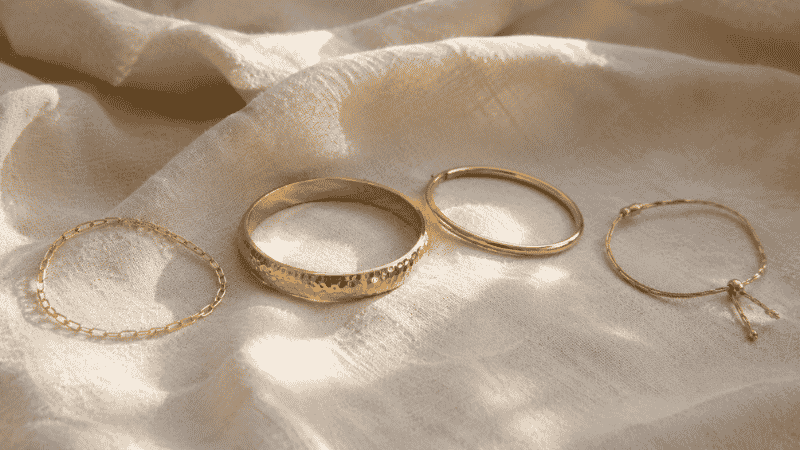
For anyone new to layering bracelets, or anyone who wants a reliable combination that doesn’t require much thought, the three-piece stack is the most consistent formula:
One anchor piece — your most visually distinctive bracelet. A bangle with texture, a thin chain with a charm, a tennis bracelet, whatever has the clearest identity.
One contrasting piece — something that differs from the anchor in at least two ways. If the anchor is rigid, make this flexible. If the anchor is polished gold, make this a different texture — a delicate chain, a simple beaded piece, a flat cuff. The contrast creates visual interest without chaos.
One filler piece — thin, simple, and quietly supportive. A plain chain bracelet, a simple bangle, a cord. Its job is to add density to the stack without competing with anything. This is the piece that could be almost anything, and often costs the least.
Three pieces with clear roles. That’s the formula. Once you have it working, adding a fourth piece becomes much easier because you understand the structure you’re building around.
How to Layer Bracelets: The Contrast Principle
The single most common mistake in bracelet stacking is layering pieces that are too similar. Three bangles of the same width and finish look like a set — cohesive but flat. Three delicate chains of the same style blur into each other. Contrast is what creates dimension.
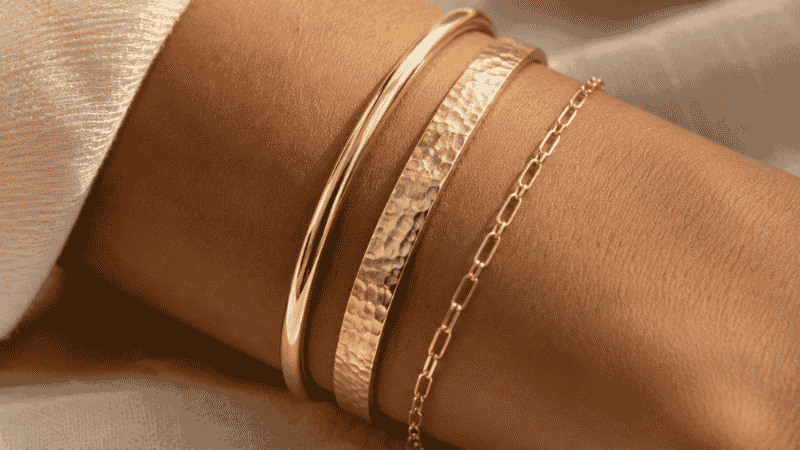
Width contrast is the most important. A thin chain bracelet next to a medium bangle next to a slim cuff creates rhythm. Three identical-width bangles create monotony. You don’t need dramatic contrast — a difference of a few millimeters in width is enough to create separation.
Texture contrast adds visual depth. Smooth polished metal next to something with a woven, hammered, or beaded surface. A chain-link bracelet next to a solid bangle. The difference in surface quality catches light differently and makes each piece more visible as a distinct element.
Shape contrast keeps things interesting. Rigid bangles and flexible chains behave completely differently on the wrist — they move differently, catch light differently, and sit at slightly different positions throughout the day. Combining both feels more dynamic than wearing only one type.
A note on mixing metals: The old rule against mixing gold and silver has essentially dissolved. Mixed-metal stacks look deliberately modern when there’s a unifying element — same finish style across metals, or a bridge piece that incorporates both. The key is repetition: if you have one gold and one silver element, the stack can feel random. Two gold pieces and one silver, or vice versa, creates enough repetition to feel intentional.
Proportion: How Many Bracelets Is Too Many?
This is the question most people have but don’t know how to answer.
The practical guideline most jewelers and stylists agree on: your bracelet stack should cover no more than one-third of your forearm. Beyond that, it stops reading as jewelry and starts reading as a costume. For most people, that means somewhere between two and five bracelets depending on the width of each piece.
For daily wear: Two to three pieces. Enough to look like a considered choice, not so many that it becomes a project every morning. The sweet spot for a stack you’ll actually put on consistently.
For casual occasions: Three to four pieces. Room for something a little more expressive — a charm bracelet, a bead element, a slightly bolder cuff.
For evenings or special occasions: Four to five pieces, leaning into statement. This is when you can add a wider cuff, a more elaborate chain, or a tennis bracelet that you’d find too formal for every day.
The other proportion consideration is wrist size. Thinner wrists often look better with finer, more delicate pieces — chunky cuffs can overwhelm a small wrist and look off-balance. Wider wrists can carry more weight and scale, and actually look better with at least one more substantial piece in the mix.
Building a Stack From Scratch When You Have Nothing
If you’re starting from zero, the most practical approach is to build incrementally rather than buying a “set” all at once.
Start with one good-quality piece in your metal of choice — something you’d genuinely wear alone. A simple bangle, a thin chain bracelet, a piece with some personal meaning. Wear it that way for a few weeks. Notice how it feels on your wrist, what outfits it works with, what feels missing.
Then add a second piece that creates contrast with the first. If your starting piece is a rigid bangle, look for a flexible chain. If it’s delicate, look for something with slightly more visual weight.
Then observe. Often, two pieces is enough — many people who think they want a full stack discover that two well-chosen bracelets are exactly right for them.
If you want more, add a third piece — thin, simple, a quiet presence. A plain thin bangle, a cord, a delicate chain.
Building this way takes longer but results in a stack where every piece was chosen deliberately, fits your actual style, and gets worn. The alternative — buying six bracelets at once and hoping they work together — usually results in a drawer full of pieces that never quite feel right together.
Layering Bracelets With a Watch

A watch already functions as a bracelet — it occupies wrist space and has its own visual weight. Adding bracelets alongside it requires slightly different thinking.
The watch should almost always be the anchor piece. It’s the most structured element, and everything else should respond to it.
Delicate pieces work best alongside watches — thin chains, simple bangles, nothing that competes with the watch face or strap. The stack should complement the watch, not fight it.
Place the watch first, then arrange bracelets on the same side or the other side of the watch depending on the look. Some people prefer all bracelets on the watch side; others separate watch from stack by wearing one on each wrist.
Avoid pairing a large, chunky watch with equally chunky bracelets — the combination is too heavy. If you love a statement watch, let it stand mostly alone with one or two thin pieces alongside it.
When Your Stack Doesn’t Look Right: The Quick Diagnosis
You’ve put something together and it’s not working. Before taking it all off, try diagnosing what’s off:
Everything looks the same: Add contrast in at least one dimension — width, texture, or finish. Even one contrasting piece changes the whole feel.
It looks heavy or overwhelming: Remove one piece and see if it improves. Usually, the piece that goes is whichever one is most similar to another piece in the stack.
Nothing has a clear focal point: Identify your anchor and let everything else step back. If two pieces are competing to be the most interesting, one of them needs to go or be replaced with something quieter.
The stack keeps sliding or bunching: Size is the issue. Bracelets that are too large slide constantly; too small and they bunch up and feel tight. A properly sized bracelet allows about one finger’s width of movement without sliding off.
It looks perfectly assembled but feels wrong: Trust that feeling. A stack that requires constant adjustment won’t get worn. Comfort and wearability matter as much as how it looks.
How to Layer Bracelets for Different Occasions
Everyday at work: Two to three pieces maximum. Stay within one metal tone or keep contrast subtle. A tennis bracelet or simple chain plus one bangle is the most versatile combination — polished enough for professional settings, relaxed enough for everything else.
Weekend casual: Three to four pieces, more room for personality. This is when you can bring in a beaded piece, a charm bracelet, something with color. Let the stack feel a little more gathered and personal.
Evening or event: Three to five pieces leaning into elegance. A tennis bracelet becomes the anchor. Add a slim bangle and one chain. Keep the finishes consistent — all high-polish, or all the same metal — and the formality comes naturally.
Travel or active days: Two pieces maximum, both secure and low-profile. Chain bracelets that can snag, large bangles that bang against surfaces, or anything that needs adjustment throughout the day should stay home. Travel is when you discover which pieces are truly wearable.

FAQ
How many bracelets should you layer? Two to four is the most practical range for daily wear. Three is the number most often cited as the sweet spot — enough to look intentional, not so many that it becomes complicated. For special occasions, four to five can work beautifully with the right pieces.
Can you layer bracelets on both wrists? Yes, but keep the dominant wrist stack simpler and more practical — it moves more and encounters more friction throughout the day. The non-dominant wrist can carry a more elaborate stack.
How do you keep layered bracelets from tangling? Mix rigid bangles with flexible chains rather than all flexible pieces, which tangle more easily. Using pieces with similar closure styles (all lobster clasp, or all slide-over) helps too. A necklace layering clasp adapted for bracelets can hold multiple pieces together at a single point.
Can you mix gold and silver bracelets in a stack? Yes — mixed-metal stacks look modern and intentional when there’s repetition: two pieces of one metal and one of the other, or a bridge piece that incorporates both. The key is making it look deliberate rather than accidental.
What’s the best first bracelet for starting a stack? A simple, clean bangle or thin chain bracelet in your metal of choice — something you’d wear alone and feel good about. This becomes your anchor for everything you add later.
A bracelet stack that looks effortless is almost always the result of a few deliberate choices: one anchor piece with a clear identity, contrast in at least one dimension, and a proportion that feels comfortable rather than overwhelming.
The rest is yours to play with. The formula gives you a foundation; your actual instincts do the rest.
Related reading:
- How to Layer Necklaces: The Formula That Always Works → [internal link]
- How to Stack Rings → [internal link]
- How to Choose Jewelry That Actually Feels Like You → [internal link]
Sources:
- Brilliant Earth — How to Stack Bracelets: Bracelet Stacking & Layering Guide
- Artizan Joyeria — How to Create a Bracelet Stack From Scratch (July 2024)
- Amorium Jewelry — How to Stack Bracelets: The Complete Guide to Bracelet Layering (March 2026)
- Sylvie Jewelry — How to Stack Bracelets: Expert Styling Tips (June 2025)