
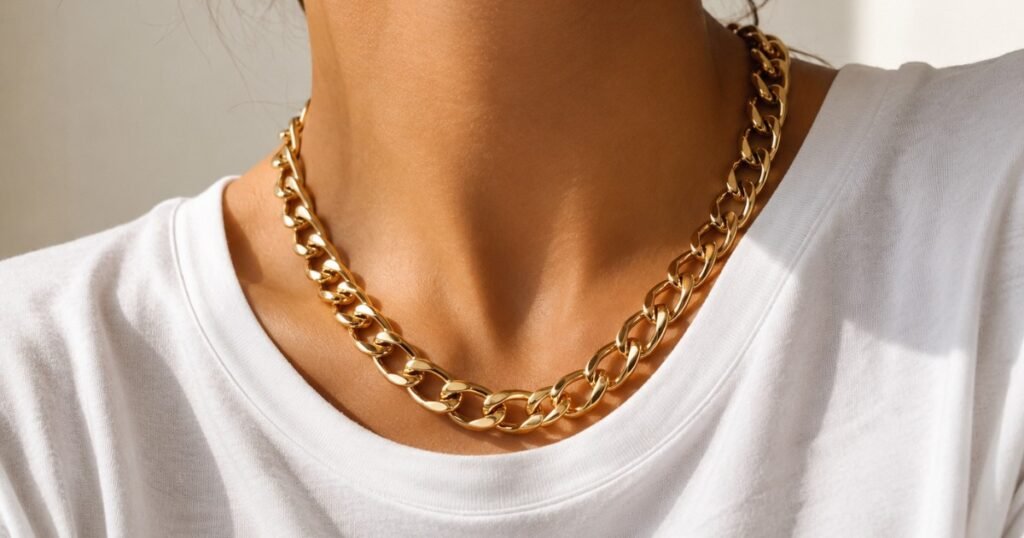
I bought a chunky gold chain necklace last spring. Wore it to the office exactly once, spent the entire day convinced everyone was staring at me, came home and put it back in the box. It sat there for three months.
Then I wore it with a plain white tee, jeans, and sneakers on a Saturday. Nobody stared. Several people said I looked great. I wore it every week after that.
The problem was never the necklace. The problem was that I’d paired it with a printed blouse, which meant two things were competing for attention simultaneously. The necklace felt like too much because the outfit was already too much. Simplify the outfit, and the necklace suddenly had room to breathe.
If you’ve ever bought a bold piece and then talked yourself out of wearing it — because it felt too formal, too try-hard, too much like you were going somewhere you weren’t — this guide is for you. The issue isn’t the jewelry. It’s the approach.
✨ Before You Wear Statement Jewelry
Use this quick checklist whenever you’re styling a bold piece:
✅ Choose one statement piece as the focal point.
✅ Pair it with simple, everyday clothing.
✅ Make sure the size complements your body frame and neckline.
✅ Pick lightweight, comfortable materials for all-day wear.
✅ Layer thoughtfully instead of wearing matching jewelry sets.
✅ Wear pieces you’ll enjoy beyond special occasions.
✅ Let your confidence—not your accessories—make the biggest statement.
What Is Statement Jewelry and Why It Elevates Your Everyday Look
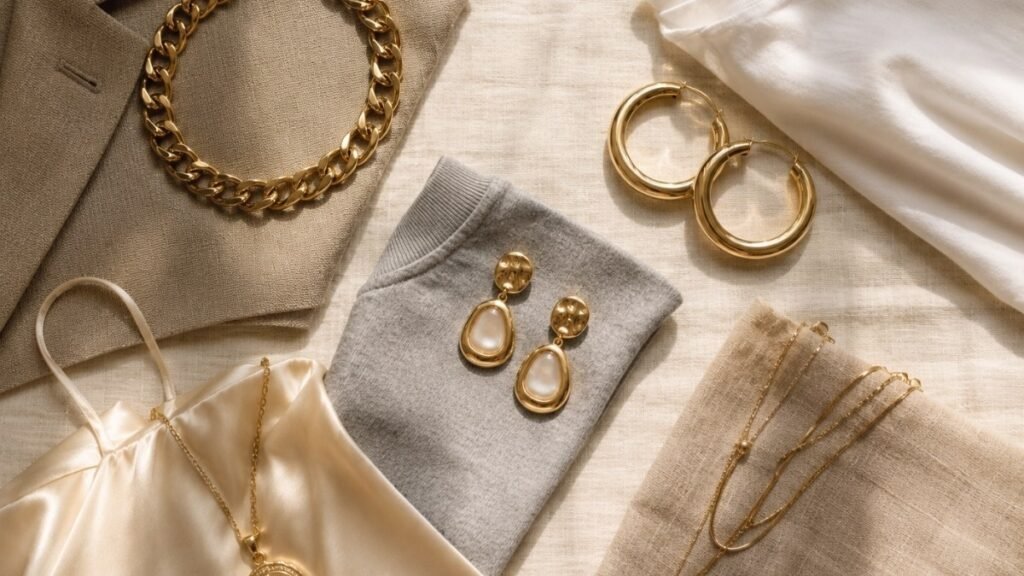
Statement jewelry isn’t just oversized
The word “statement” gets attached to anything large and bold, but that’s a limited definition. Statement jewelry is any piece that creates a focal point — that draws the eye and does the expressive work in an outfit. A chunky chain can be a statement. So can a single oversized sculptural ring. So can a pair of long chandelier earrings that catch the light when you turn your head.
Size is one way to make a statement. Unexpected shape, distinct texture, or a single bold material choice are others. Some of the most striking “statement” pieces I’ve seen are actually quite small — a single large baroque pearl earring, an architectural ring in an unusual form. The point isn’t volume. It’s intention.
Different types of statement pieces
Statement earrings are the most wearable entry point for most people. They don’t require any outfit adjustment — you just put them on. Oversized hoops, long drop earrings, geometric studs with real presence, shoulder-grazing dangles. Earrings do their work from the face upward, which means they’re visible in photos, in conversation, across the table. They require the least commitment.
Statement necklaces have the most direct relationship with the outfit’s neckline — which means they require the most consideration but offer the most dramatic transformation when you get it right. A bold chain, a bib necklace, a large pendant, a dramatic collar.
Statement rings are the most personal category. A large stone, an unusual form, a stacked combination that takes up two knuckles — these are intimate, visible only up close, and particularly meaningful because hands are always in motion.
Statement bracelets — a wide cuff, an armful of bangles, a sculptural piece that sits at the wrist — are the most effortless category for daytime wear because they don’t affect neckline or face framing. They work alongside whatever else is happening in an outfit.
Why one bold accessory often looks more stylish than many small ones
This is genuinely counterintuitive, but consistently true: one piece with real presence, surrounded by quiet, looks more considered than five subtle pieces competing for the same attention. The single statement piece has the whole outfit as its backdrop. The five subtle pieces have each other, and the resulting visual noise makes everything feel like less.
There’s a reason fashion editors — actual humans who spend their days thinking about this — consistently reach for one interesting piece and let everything else step back. It’s not restraint for restraint’s sake. It’s understanding that clarity reads as confidence.
Why Most People Feel Overdressed in Statement Jewelry
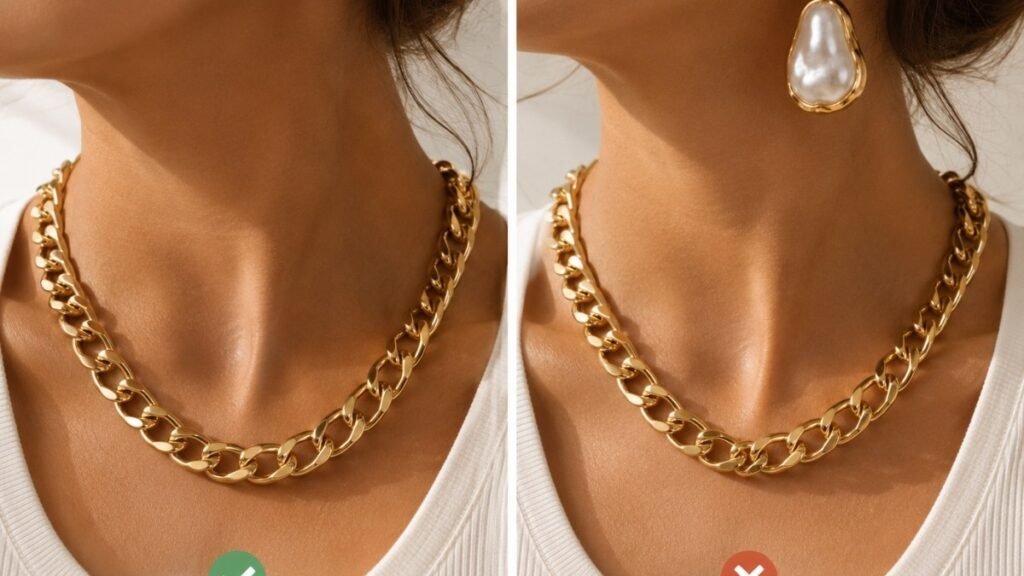
The fear of “trying too hard”
Reddit’s jewelry and fashion communities are full of this exact anxiety. “I love this piece but I feel like I’m making a statement I’m not qualified to make.” “I’m not the kind of person who wears things like this.” “It feels like I’m trying to be someone I’m not.”
This is one of the most universal experiences in personal style — the gap between what you’re drawn to and what feels safe to actually wear. It’s particularly common with jewelry because jewelry is personal and visible in a way that, say, a coat isn’t. A coat covers you. A necklace presents you.
The fear of trying too hard is almost always about imagined audience judgment rather than actual judgment. In reality, most people register a bold earring as “she looks put together” and move on. The extensive mental narrative about how you’ll be perceived is almost entirely internal.
Why occasion stereotypes hold people back
We absorb associations between certain jewelry and certain contexts over years of cultural exposure. A large statement necklace reads as “gala.” Drop earrings read as “date night.” A chunky gold ring reads as “special occasion.” These associations aren’t rules — they’re patterns that exist because people mostly save bold pieces for events.
The irony is that bold jewelry on a regular Tuesday, worn with casual clothes, often looks more interesting than the same piece at a formal event where it’s competing with everyone else’s formal jewelry. The element of surprise — a stunning earring at the coffee shop — is part of what makes it striking.
The mindset shift: Style isn’t about saving jewelry for special events
The pieces you wear every day are the pieces that define your style. The ones in the box for special occasions are the ones that never quite get worn because special occasions have their own pressures and you revert to safe choices.
The more useful mental model: think of bold jewelry as the thing that makes ordinary days feel slightly more considered. Not elevated for events — just present for life. The necklace you’d wear to a gala is also the necklace you can wear to the farmer’s market if you pair it correctly.
The Golden Rule of Styling Bold Jewelry: Finding the Perfect Balance
One statement piece deserves the spotlight
Pick one. Not the earrings and the necklace and the rings. One piece that makes the point, and everything else that supports it quietly. This is the single most important principle in styling bold jewelry, and it’s the one most people skip.
If the earrings are the statement, keep the necklace simple or skip it entirely. If the necklace is the statement, wear small studs or nothing in your ears. If the ring is the statement, keep the wrist quiet and the neckline clean.
The exception — and there is one — is when you’re deliberately going maximalist, in which case the principle becomes “everything must be intentional” rather than “one piece.” But intentional maximalism requires more experience to pull off. If you’re figuring out how to wear bold jewelry, start with one piece and expand from there.
Keep clothing clean and simple
The outfit is the backdrop. A statement piece needs a simple background to read clearly. A white tee. A solid-color dress. A plain sweater. A clean linen shirt. Anything that doesn’t compete for the same visual real estate.
Prints, patterns, textures, and details all reduce the impact of the jewelry sitting on top of them. This is why a large necklace on a floral blouse reads as chaotic while the same necklace on a white tee reads as intentional. The white tee is doing nothing, which means the necklace gets to do everything.
Balance volume, color, and texture
If the jewelry is large in scale, keep the clothing silhouette simple. If the jewelry is colorful, let the outfit be neutral. If the jewelry has significant texture (hammered metal, woven chain, faceted stones), let the fabric be smooth and quiet.
These aren’t rigid rules — they’re conversations between the outfit and the jewelry. The goal is for them to be in dialogue, not competing monologues.
When less really is more — a Do & Don’t reference
| Do | Don’t |
|---|---|
| One bold piece + simple outfit | Multiple statement pieces simultaneously |
| Statement jewelry on a plain background | Bold jewelry over a busy print |
| Match jewelry scale to outfit formality | Wear event jewelry with casual clothes without adjusting |
| Let the piece have visual space | Stack unrelated bold pieces |
| Wear something you’d wear in daylight | Save everything for special occasions |
How to Wear Statement Necklaces with Different Necklines
Crew neck
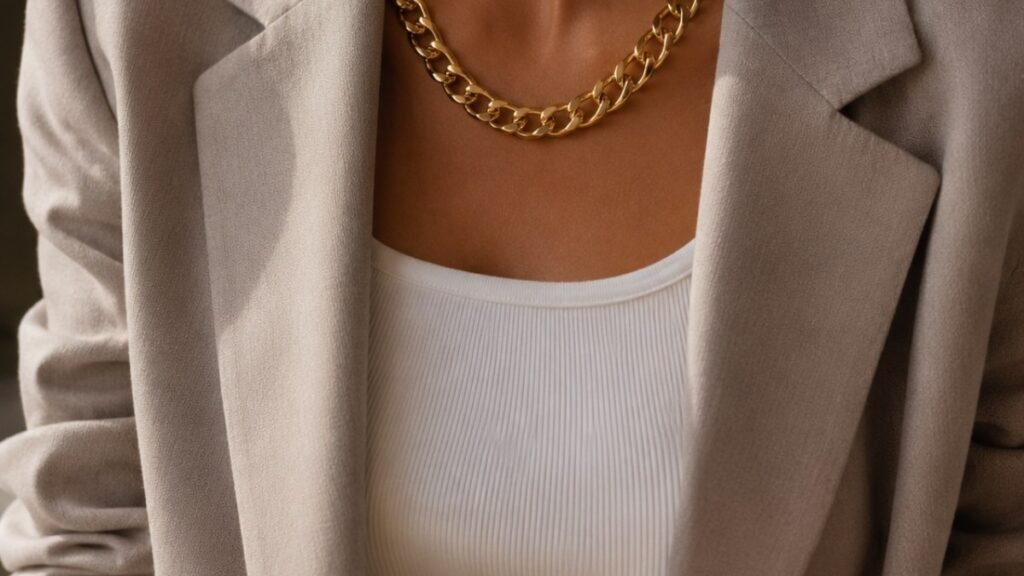
A crew neck is one of the best backgrounds for a statement necklace because the high, simple neckline creates a clear stage. The necklace sits against the fabric or just at the neck edge, with the outfit providing a clean backdrop. A chunky chain at 18 inches or a bold pendant resting just above the crew neck neckline reads immediately and clearly.
V-neck
The V creates a natural downward line. A statement necklace here should follow that line — a Y-chain, a long pendant that falls with the V, or a layered necklace that echoes the opening. Avoid a very short statement choker on a V-neck; it sits at cross-purposes with the neckline’s direction and creates visual tension.
Square neckline
The horizontal quality of a square neckline is beautifully complemented by a necklace that falls just below it — 18 to 20 inches — and has some width or presence. A small bib necklace, a wider chain, or a pendant with horizontal spread all work with the geometry of a square neckline.
Off-shoulder
With bare shoulders and collarbone exposed, the neckline area is already a focal point. A bold choker or collar-style statement necklace fills that space intentionally. Or — and this is often the better choice — keep the neck completely clear and let a pair of dramatic drop earrings do the statement work, which creates elegance without adding visual weight to the already-bare neckline area.
Shirt collars
A button-down collar is one of the more complex necklines for statement jewelry because the collar itself is already a detail. A statement necklace worn over a closed collar competes with it; worn inside an open collar it can look intentional. The safer approach with a collared shirt: skip the necklace and go with statement earrings or a statement ring, which work with the collar rather than fighting it.
Turtlenecks
No space for a necklace, which is actually a gift. Statement earrings — long drops, sculptural forms, larger hoops — are freed from any competition with a neckline when you’re wearing a turtleneck. They’re the entire jewelry story. Long necklaces worn on top of a turtleneck (22+ inches that falls over the fabric) can also look striking and intentional.
How to Choose Statement Jewelry for Your Body Shape and Face Shape
Petite women
Scale matters here more than anywhere else. A piece that’s proportionate on a taller person can overwhelm a petite frame. The most flattering statement pieces for petite women tend to be bold in detail but not enormous in scale — a statement earring that’s interesting in shape rather than 4 inches long, a chain with presence but not significant weight, a ring that makes a point without extending past the first knuckle.
Reddit’s petite fashion communities consistently come back to this: scale the piece to your frame, not to what reads as “statement” on a size 12, 5’9″ model.
Tall women
More frame to work with, which means scale can go up. A longer pendant necklace reads beautifully on a taller woman in a way it doesn’t always on someone shorter. Wide cuffs, larger hoops, longer drop earrings — these all have more visual space to occupy without overwhelming.
Full bust styling
Necklaces that end at the bust line — common pendant lengths of 18 to 20 inches — can draw the eye in a direction that doesn’t feel comfortable for everyone with a fuller bust. Longer necklaces (22+ inches), statement earrings, or statement rings shift the visual interest elsewhere. This isn’t a hard rule — it’s a proportion consideration. Try different lengths and see what feels balanced for you specifically.
Round vs long face
Round faces are complemented by length — long drop earrings that create a vertical line, a longer pendant necklace, geometric shapes with angular qualities. These add the appearance of elongation.
Long or oval faces are balanced by width — larger hoops, chandelier earrings that spread horizontally, shorter pendant lengths that don’t add further length. Round and circular shapes complement angular bone structure.
Neck length considerations
Shorter necks look best with statement pieces that don’t sit directly at the throat — chokers can visually shorten an already-short neck. Slightly longer chains (16 to 18 inches) or earring statements are more flattering. Longer necks can carry chokers and collar necklaces beautifully.
5 Ways to Style Statement Jewelry for Everyday Casual Scenarios
Office Chic: Blazer + Tank + Chunky Chain
The outfit formula: A solid-color blazer over a simple tank or tucked-in tee, with a single chunky chain necklace.
Why it works: The blazer provides structure and signals professional intentionality; the tank gives the necklace a clean background; the chunky chain adds personality without compromising the overall polish. This is one of the most versatile work-appropriate statement looks because the blazer keeps everything grounded in professional register.
Keep earrings simple — small studs or tiny hoops. Let the chain be the singular point.
Coffee Date: White Tee + Denim + Gold Hoops
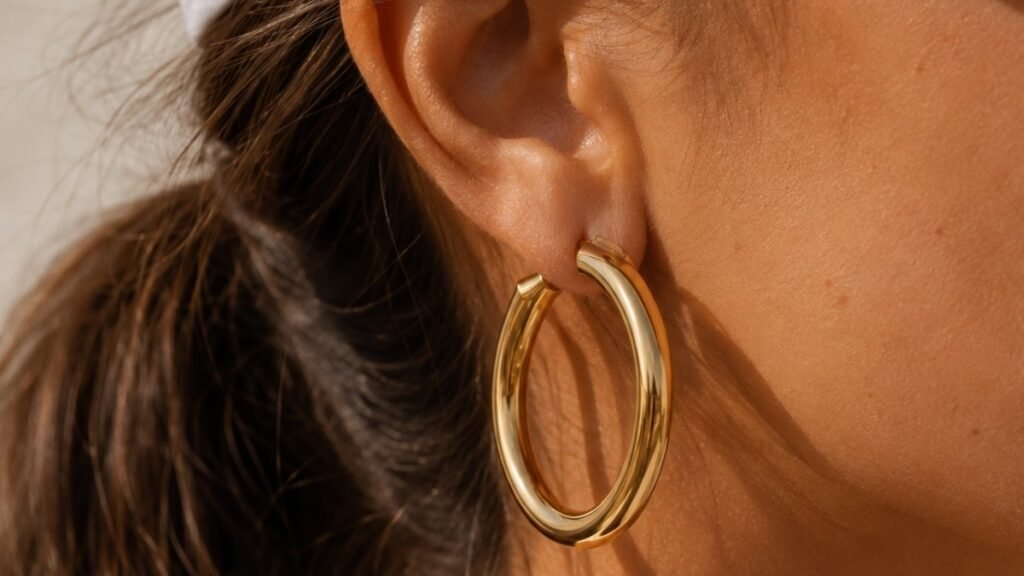
The outfit formula: A white or off-white tee (tucked or half-tucked), your best-fitting jeans, and a pair of oversized gold hoops — 30 to 40mm.
Why it works: This is the formula that converts the most statement-jewelry skeptics. The white tee is the most neutral backdrop available. The denim is casual and unambiguous. The oversized hoops add exactly one thing: elegance. The whole look takes forty-five seconds and consistently reads as intentional rather than overdressed.
No necklace. One ring if you want it. Everything else stays quiet.
Weekend Errands: Sweatshirt + Baseball Cap + Bold Earrings
The outfit formula: An oversized sweatshirt, a clean cap, and a pair of statement drop earrings or bold studs.
Why it works: This is the combination that surprises people most — bold earrings with a baseball cap reads as effortlessly cool in a way that very few other combinations achieve. The cap is casual; the earrings are elevated; the contrast between them is what makes the look. It works because the sweatshirt is completely quiet, which gives the earrings the same backdrop a white tee provides for a necklace.
This look requires confidence more than anything else. Try it at home first. Then try it outside.
Dinner with Friends: Slip Dress + Vintage Pendant
The outfit formula: A slip dress (satin, silk, or anything with that ease) in a solid neutral — black, ivory, chocolate, dusty rose — with a single vintage-style pendant necklace.
Why it works: The slip dress’s simplicity creates the perfect backdrop; the pendant adds one specific point of personality without competing with the dress’s inherent elegance. “Vintage” in this context means something with a story — a piece with a stone, an unusual shape, something that looks like it came from somewhere rather than being purchased yesterday. That quality of apparent history is what makes this combination feel curated rather than assembled.
Travel Outfit: Linen Shirt + Mixed Chains
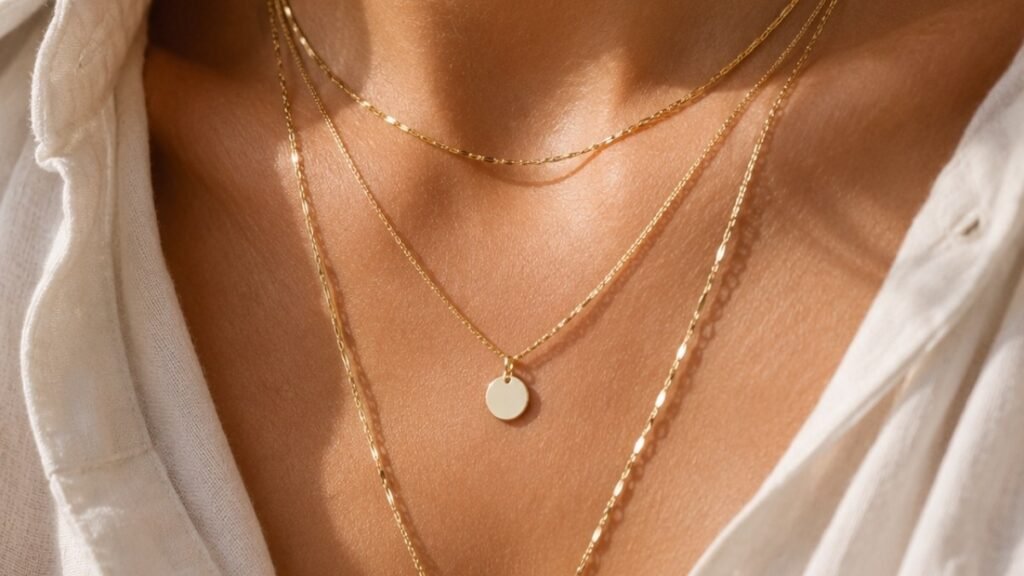
The outfit formula: A linen shirt (worn open over a tee or as a lightweight top), relaxed pants or jeans, and two or three fine gold chains at different lengths layered together.
Why it works: Travel outfits need to work in airports, restaurants, museums, and everything between. Layered fine chains create the effect of statement jewelry with none of the logistical problems — they’re lightweight, comfortable through long days, and scale beautifully from morning coffee to dinner reservation. The linen shirt’s open collar gives the chains room to be seen. The whole look says “I travel well” without requiring any effort.
Layering Instead of Buying: How to Create a Statement Look with Pieces You Already Own
Before you spend $200 on a new statement necklace, try this: go into your jewelry box and pull out two or three thin chains you already own. Try them together. Something interesting almost always happens.
This is the advice Reddit’s jewelry communities give most consistently — and it’s correct. Most people already own the pieces to create a layered statement look; they just haven’t combined them.
Why layering feels more natural
A single oversized piece can feel like too much of a commitment. Three thin chains layered together feel like a style decision — lighter, more approachable, and easier to adjust throughout the day. The layered look also feels more personal, because it’s genuinely a combination rather than a single purchased item.
The 3-necklace formula
Layer three chains: one short (14 to 16 inches, close to the neck), one medium (18 to 20 inches, at the collarbone), one longer (22 to 24 inches, falling toward the chest). The length variation is what makes the stack readable as separate pieces rather than a tangled mess. Each piece should be slightly different from the others — in weight, in chain style, or in whether it has a pendant.
Mixing chain thickness
Thin, medium, and slightly thicker chains together create visual rhythm in a way that three identical chains don’t. The variety in weight reads as intentional layering rather than accidental pile-up.
Mixing gold and silver
The modern approach to mixed metals: let one metal dominate (two gold chains, one silver, or vice versa) so the combination reads as deliberate rather than indecisive. Or use a bridge piece — a chain that incorporates both metals — to unify the mix.
Layering rings
Two or three thin bands on one finger, or a thin band and one ring with a small stone, creates a ring statement without requiring a single dramatic piece. The stack is the statement.
Layering bracelets
One anchor piece with presence, one or two thin chains or bangles alongside it. The anchor can be anything with visual weight — a cuff, a chain with larger links, a piece with a stone. The thin companions give it scale context without competing.
Smart Shopping: Choosing High-Quality, Lightweight Statement Pieces Under Budget
I bought a pair of oversized resin drop earrings a few years ago. They were beautiful. I wore them for forty minutes and my ears started aching in a specific, exhausting way that I knew meant another two hours of this would be genuinely unpleasant. They went back in the box. I’ve worn them twice since.
Weight is the most underrated factor in statement jewelry. A beautiful piece you can’t wear comfortably isn’t a beautiful piece — it’s a beautiful object that sits in a drawer.
Why heavy jewelry isn’t always better
Heavy statement pieces communicate the wrong kind of presence after a few hours. The physical weight becomes the dominant experience of wearing them, which makes you aware of the jewelry constantly — the opposite of the “put it on and forget it” ideal. Hollow construction, lighter metals, and resin or acrylic elements can create the visual impact of large jewelry without the physical weight.
| Material | Best For | Durability | Comfort | Skin-Friendly | Looks Expensive? |
|---|---|---|---|---|---|
| Gold Vermeil | Special occasions & occasional wear | ★★★★☆ | ★★★★★ | Yes | ⭐⭐⭐⭐⭐ |
| Gold Filled | Everyday wear | ★★★★★ | ★★★★★ | Yes | ⭐⭐⭐⭐⭐ |
| Sterling Silver | Daily minimalist styles | ★★★★☆ | ★★★★★ | Usually | ⭐⭐⭐⭐☆ |
| Stainless Steel | Budget-friendly everyday jewelry | ★★★★★ | ★★★★☆ | Usually | ⭐⭐⭐☆☆ |
| Brass / Alloy | Fashion trends | ★★☆☆☆ | ★★☆☆☆ | Sometimes | ⭐⭐☆☆☆ |
Gold Vermeil vs Gold Filled
For statement jewelry at accessible prices, the material distinction that matters most is between gold vermeil and gold filled — and the answer for wearable statement pieces is almost always gold filled.
Gold vermeil (real gold over sterling silver, legally required at 2.5 microns minimum) is beautiful and appropriate for statement pieces you’ll wear occasionally. Gold filled (gold comprising at least 5% of total weight, mechanically bonded rather than plated) is significantly more durable and holds up to the daily wear that statement pieces increasingly get once you’re no longer afraid to wear them. For a piece you’ll actually reach for regularly, gold filled is the smarter investment.
Avoid cheap-looking finishes
The signals that read as inexpensive: plating that’s already showing wear through the gold, sharp unfinished edges, clasps that feel flimsy, stones that look cloudy or poorly set. These are things you can assess in person or spot in detailed review photos online. A well-made affordable piece looks intentional; a poorly finished expensive-looking piece looks like it’s pretending.
How to spot quality online
Read one-star reviews specifically for mentions of tarnishing timeline, clasp failures, and skin reactions. These tell you more about the piece’s actual quality than the five-star reviews. Look for product photos that include close-ups of clasps, chain links, and any stone settings. Brands that share materials information (base metal, plating thickness, karat) are almost always more trustworthy than brands that don’t.
Try before investing
Reddit’s most consistent advice for statement jewelry: start with a lower-priced version of the style you’re drawn to. A $30 oversized hoop to confirm you can pull off the scale before buying the $150 solid gold version. A $20 chunky chain pendant to confirm you’ll actually wear it before investing in gold filled. This isn’t about buying cheap jewelry — it’s about validating a style direction before committing to it at a higher price point.
Common Statement Jewelry Mistakes That Instantly Date Your Outfit
Matching full jewelry sets
The three-piece set — earrings, necklace, bracelet in identical design — was a specific moment in fashion that has largely passed. The problem isn’t the matching per se; it’s that matching sets read as an outfit assembled by someone else rather than a style assembled by you. Individual pieces chosen for how they work together look more personal and more current than a set that announces itself as a coordinated purchase.
I know this because my first statement jewelry purchase was exactly a three-piece set. Wore all three together. Felt immediately like I was at my grandmother’s anniversary party. Have since worn each piece separately, with other things, and they look completely different.
Too many focal points
Two statement pieces simultaneously fight each other. Neither wins. The look becomes busy in a way that doesn’t read as intentional maximalism — it reads as indecision. Choose which piece will speak and let the others listen.
Ignoring proportions
A piece that’s the wrong scale for your frame, for the outfit’s formality, or for the occasion doesn’t fail in an obvious way — it just looks slightly off in a way that’s hard to diagnose. Too small and the piece disappears; too large and the outfit disappears under the piece. Scale is as important as style.
Poor material choices
Base metal pieces that tarnish within weeks, plating that wears through to reveal a different-colored metal, stones that cloud or lose their finish — these undermine the whole point of wearing a statement piece. A statement piece is supposed to make a point about your style. A tarnished or worn statement piece makes a different point entirely.
Wearing oversized jewelry with busy prints
The outfit competes with the jewelry. Both are trying to be the focal point. Neither succeeds. Bold jewelry on a bold print reads as visual noise rather than a style statement. Let one thing be the pattern; let the other be the jewelry.
How to Clean and Store Your Bold Jewelry Pieces
Prevent tarnishing
Wipe pieces down after wearing with a soft microfiber cloth to remove skin oils, lotion residue, and sweat before they have time to react with the metal. Store in airtight bags or anti-tarnish pouches between wearings — particularly for silver and gold vermeil pieces that react to air exposure. Keep away from bathroom humidity, which accelerates oxidation even on pieces that aren’t being worn.
Travel storage tips
A pill organizer with individual compartments keeps small statement pieces separated without tangling. For longer necklaces, thread them through a drinking straw before coiling to keep chains from knotting during transit. A flat jewelry roll with individual slots protects pieces from each other and from the bag’s other contents.
Prevent necklaces from tangling
The most effective prevention: clasp the necklace before storing it. An open clasp is the primary cause of chain tangles — the loose end catches on other links constantly. For layered chains stored together, individual small zip-lock bags per piece take thirty seconds and prevent the kind of tangling that requires twenty minutes and a straight pin to undo.
Seasonal care
Pieces stored for a season benefit from a brief clean before re-wearing — even well-stored jewelry accumulates some oxidation over months of non-use. A quick pass with a polishing cloth before the first wear of the season brings the piece back to its original finish without requiring a full cleaning process.
FAQ
Can I wear statement earrings and a statement necklace together? It’s possible, but it requires deliberate handling. If you’re wearing both, they need to be in clear conversation rather than competition — similar metals, complementary scales, one clearly more prominent than the other. In practice, most stylists recommend choosing one and keeping the other quiet. If both pieces are at full volume simultaneously, neither reads as a statement — they read as excess.
How do I make statement jewelry look casual instead of dressy? The outfit does this work more than anything else. A statement piece on a white tee and jeans reads as casual. The same piece on a silk blouse reads as formal. Simplify and casualize the outfit — plain basics, relaxed fit, flat shoes — and the jewelry’s formality level drops with it. The piece doesn’t change; the context does.
Is statement jewelry suitable for work or business casual outfits? Yes, with calibration. A single bold piece — a chunky chain on a simple blazer, a pair of large hoops with a tailored top — reads as personal style rather than inappropriately formal or distractingly casual. The key is keeping everything else in the outfit clean and professional so the statement piece looks intentional rather than like you forgot to change.
What statement jewelry looks best on petite women? Pieces that are bold in detail rather than large in scale. An interesting geometric earring shape, a chain with distinctive links, a ring with a real presence — these read as statement without overwhelming a smaller frame. The Reddit petite fashion community consistently recommends trying pieces on (or looking for honest scale photos from reviewers with similar builds) before buying based on product photography.
How can I layer delicate necklaces to create a statement look? Use the three-length formula: 14 to 16 inches (collar), 18 to 20 inches (collarbone), 22 to 24 inches (chest). Vary the chain styles — a smooth cable chain, a textured curb chain, a small pendant on a delicate chain. The combination of varying lengths and slightly different chain styles creates the visual richness of a statement piece without requiring any single dramatic element.
What’s the difference between gold vermeil and gold-filled statement jewelry? Gold vermeil is real gold over sterling silver, at a legally required minimum of 2.5 microns. It’s beautiful and appropriate for statement pieces worn occasionally. Gold filled has a significantly thicker gold layer — at least 5% of total weight, bonded mechanically — and is substantially more durable for pieces worn regularly. For statement jewelry that you intend to reach for frequently, gold filled is the better investment.
How do I keep large necklaces from tangling or tarnishing? Clasp before storing — always. An open clasp is the main cause of chain tangles. Store in individual airtight bags or anti-tarnish pouches to slow oxidation. Wipe down after each wear to remove the skin oils and product residue that accelerate tarnishing. For travel, thread chains through a straw before coiling.
Final Thoughts
The best statement jewelry isn’t the biggest piece in your collection—it’s the piece that makes you feel like the best version of yourself.
Whether it’s a pair of bold hoops, a chunky chain necklace, or a stack of layered rings, great style comes from wearing each piece with confidence rather than saving it for a “special occasion.”
Start small if you’re new to statement jewelry. Experiment with simple outfits, discover what feels natural, and let your collection evolve alongside your personal style. Fashion isn’t about following every rule—it’s about finding the balance that feels authentically yours.
✨ Jewelry Styling Notes: The Philosophy Behind This Guide
Great style isn’t about owning the biggest jewelry collection.
More often, it’s about understanding how one thoughtfully chosen piece can transform outfits you already wear. A statement necklace, bold earrings, or stacked rings should feel like an extension of your personal style—not something reserved for weddings or special occasions.
This guide is built around three simple ideas:
✨ Everyday Styling First
Learn how to wear statement jewelry with office outfits, casual weekends, coffee dates, and everyday essentials instead of saving it for rare occasions.
💎 Quality Over Quantity
Understanding materials like Gold Vermeil and Gold Filled helps you choose pieces that look luxurious, feel comfortable, and last longer without overspending.
🤍 Confidence Creates the Statement
The goal isn’t to wear the biggest necklace or boldest earrings.
It’s to wear jewelry naturally—so it feels effortless, comfortable, and uniquely yours.
Because great style isn’t about attracting attention.
It’s about expressing personality with confidence.
Continue Building Your Jewelry Collection
Finding your personal style doesn’t stop with one article.
These guides can help you build a versatile jewelry wardrobe you’ll actually wear.
- Jewelry for Casual Outfits: How to Look Effortlessly Put-Together → [internal link]
- How to Layer Necklaces: The Effortless Formula → [internal link]
- What Is Gold Vermeil? The Honest Guide → [internal link]
✨ A Note from Aceloduo
At Aceloduo, we believe jewelry should be worn, loved, and enjoyed—not left waiting in a jewelry box for the “perfect” moment.
That’s why we’re passionate about sharing practical styling advice, honest material guides, and timeless inspiration to help you choose pieces you’ll reach for again and again.
Thank you for spending time with us. We hope this guide gives you the confidence to wear your favorite jewelry more often, celebrate everyday moments, and express your style in a way that feels uniquely your own.
Because every day is worth a little sparkle. ✨